Showing posts with label HMANA Tours. Show all posts

Tuesday, August 23, 2016

"HMANA Get-together" Weekend in Cape May - October 14-16

Bald Eagle @ Cape May - Tom Reed
This fall, October 14-16, HMANA will be running the first in what we hope will be a series of low-cost, self-drive events around the country at Cape May, New Jersey. The idea is to pick one place each fall and spring to meet other HMANA members and raptor afficionados at for a weekend of raptor watching adventures. HMANA will provide participants with local expert leadership on the ground and a weekend long itinerary which you can keep to as much as you would like. There will be a reception with food and drinks and we will send you an electronic welcoming pack with loads of inside tips on the area with great ideas on where to stay, where to eat (if you want to say slip away for a romantic meal rather than stay with the group), places you’ll want to visit if you decide to extend your stay, maps and lots of other cool tidbits of information.

Juvenile Peregrine Falcon - Tom Reed
If you’ve ever been to a HMANA Conference, or on one of our longer tours, you will know that one of the best things about them is the opportunity to meet and make friends with people from across the country who love hawks just as much as you do. The idea of these weekend "Get-together" events is to provide members with the same sense of community and chances to make new friends and networking connections as these other events but at a lower cost and with a shorter time commitment.

Golden Eagle - Tom Reed
Of course picking Cape May, New Jersey to kick off the series was something of a no-brainer. The hawkwatch platform must be as close as it is possible to get to hallowed ground for your average hawkwatcher and the whole town is nothing short of a Mecca for most birders. There’s a reason that you will probably find more famous birders per square mile in Cape May than in any other part of the United States and that simple reason is the birds. Cape May is one of those places where migration can be truly magical and it’s probably also one of the only places where the phenomenon of migration has inspired a book about both the place and its characters.

Northern Goshawk - Tom Reed
For hawkwatching fans, Mid-October is a great time to visit the Cape as many falcons and accipiters reach the peak of their fall flight. It’s also a great time to potentially pick up some of those highly prized later migrants like Golden Eagle, Northern Goshawk and Rough-legged Hawk. Mid-October is also edging into vagrant season in Cape May when almost anything that migrates might show up including the possibility of an off course Swainson’s Hawk. I remember my anticipation being so high on my first visit to Cape May that I could barely sleep and the first night I found myself wandering the streets of Cape May at about 3:00am listening to the plaintive calls of migrant thrushes as I waited anxiously for dawn.

Swainson's Hawk @ Cape May - Tom Reed
Expert guidance for this trip will be provided by Tom Reed. Tom is not only a member of the HMANA board but also one of Cape May’s previous hawkwatchers. As well as currently working for Cape May Bird Observatory as their Migration Count Coordinator he is also one of the few employees of CMBO who grew up in the area, making him the perfect person to supply us with a great itinerary and lots of insider information. Tom also provided the incredible photographs that festoon this blog post. We do hope that you can join us for the fun. For more information and to book your place visit our website (here).

Wednesday, January 13, 2016

HMANA Raptor ID Workshop 2016 - Be there or be.....

2014 HMANA ID Workshop at Braddock Bay - Luke Tiller
Come join HMANA for perhaps the only full scale tour in the country where the specific focus is improving your hawkwatching skills. The tour takes place in Western New York State in spring for good reason: unlike Fall, Spring Migration is an intense affair packed into a relatively short space of time. This compressed migration allows us to pick up early migrants like Red-shouldered Hawks, Golden Eagles and Northern Goshawks as well as late season movers like Broad-winged Hawk all in the same week. 

The tour is aimed at those with some experience watching hawks but will be of value to anyone from beginner level on up. Having two expert leaders allows us to focus on the specific needs of individuals and to give hands on instruction in one-on-one scenarios. Previous participants have ranged from beginner hawkwatchers all the way through to counters at well-known hawkwatches. The main requirement is enthusiasm for time watching raptors.


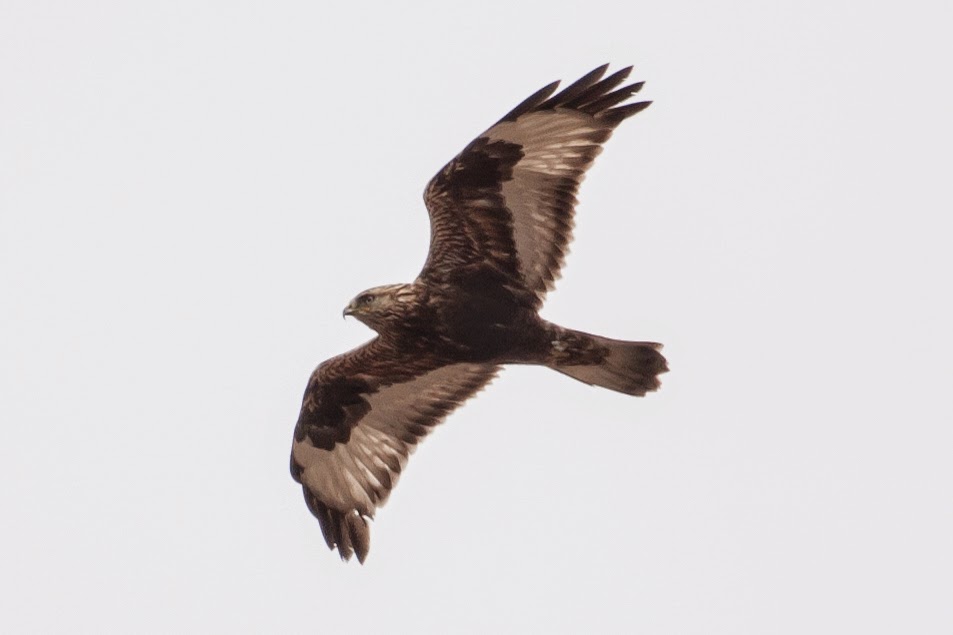
Rough-legged Hawk from HMANA ID Workshop 2015 - Luke Tiller
As well as working on identification of raptors we will focus, where possible, on aging and sexing birds as well as discussing subspecies and plumage types. As well as being instructional tour guides Frank Nicoletti and Luke Tiller pride themselves on providing a fun and relaxed atmosphere conducive to learning about identifying hawks in flight. Visits to the BBRR banding stations will allow us to get up close and personal with a number of raptors and study some key identifiers in hand. 

Check out these incredible days from tours past: This one included 5000 raptors including 46 Rough-legged Hawks and two dark morph Swainson’s Hawks (hawkcount report here), and this one almost 5000 raptors including a sweep of all possible buteos: 67 Rough-legged Hawks, Swainson’s Hawk, Black Vulture, Krider’s and dark Red-tailed Hawks (hawkcount report here). 


Saw-whet Owl from HMANA ID Workshop 2014 - Luke Tiller
This year the tour is pushed back to a slightly later start date. This means that we have a better chance of encountering one of those big Broad-winged Hawk days that Braddock Bay is known for. You can read tour leader Luke Tiller’s write up of a Braddock Bay flight that fell into this tours time frame in a previous season on his blog (here), and if the birding gods really smile upon us there is always the chance of something like this 37K raptor flight being  repeated(read about it on Luke's blog here).

Frank and Luke have both counted at Braddock Bay and have intimate knowledge of the region and the weather systems which makes sure that the group gets absolutely the best experience on any specific day. When flight conditions are not optimal we will visit places like Montezuma NWR, a great site for raptors and more,
 to see where much of the work was undertaken to reintroduce Bald Eagles to New York State and beyond.


2014 HMANA ID Workshop at Braddock Bay - Luke Tiller
As well as diurnal raptors we will be looking out for owls, visiting the BBRR Saw-whet banding operation, keeping our eyes peeled for a late Snowy Owl and checking out places where Short-eared Owl often gather to hunt. As well as all the raptors we will hopefully witness some of the incredible sky-blackening flights of passerines that can be seen along the Great Lakes, and get some instruction on IDing these birds too, as well as looking for specialist species like Trumpeter Swans, Sandhill Cranes and a wealth of wintering and migrant birds.

You can check out reports from previous year’s tours on our website and 
find out how to make bookings for the tour (here). You can check out a photo album of some of last years tour (here).

Wednesday, December 23, 2015

HMANA Raptors of the Rio Grande Valley Tour 2016

Great Kiskadee - Luke Tiller
Monday, November 9th 2015
Meeting at our hotel in Harlingen, TX the obvious and planned first stop for our tour was out east towards the coastal plain that held one of our key target species: Aplomado Falcon. Counting against heading towards the proposed Aplomado site was the fact that multiple birders had found their cars recently stranded in the once dirt, now Battle of the Somme-esque mud, road that had been created by Hurricane Patricia as she’d passed through. There was also the allure of a Hook-billed Kite sighting a few days previously to our west in McAllen. I had warned participants that they key to a successful trip would be a little flexibility and the morning therefore started with plans thrown out the window and the group racing towards Anzalduas Park. 

Right on the border, the park provides both a great view of the river and thanks to the dam road levy a great site to look for raptors. As we arrived at the park we were soon stumbling upon the first specialties of the region with Cackling Great Kiskadees and garrulous Green Jays. As we approached the levy I noticed a new bunch of signage warning people not to go up on it. Assuming they just meant cars I breezed past only to get stopped by the passing border patrol. Apparently the new rules meant no foot traffic either. I asked the officer if we stayed off the road itself whether we could stand right at the very top of the entrance ramp to the levy. Thankfully the officer said yes as our new view was affording us some nice looks at some highly prized species including stunning Summer Tanagers and Altamira Orioles. Not long after our run in with border patrol, out towards Mexico we spotted what must be the holy grail for raptor fans in Southern Texas: the oddly paddle-winged, long-tailed shape and strangely acrobatic flight of a brilliant Hook-billed Kite! This was the bird we had come for. Found all the way south to Northern Argentina, the range of the species barely touches the tip of this little tropical part of Texas and is even here rarely seen. It is possible to come here for many years and not see one, so this was an incredible start to the trip!

Green Jay - Luke Tiller
After all enjoying scope views of the flying kite we decided to see whether we could see the bird from closer to the river and scout out what else was in the park. Beyond the kites there was much else here to enjoy including a couple of locally rare birds that seemed to have been swept in by Hurricane Patricia: Greater Pewee and Dusky-capped Flycatcher. Both species are also pretty limited in their US range to Arizona and New Mexico so were not birds we had anticipated on the tour. After these exciting out-of-place finds we stumbled on another couple of unlikely birds: first up were two Audubon’s Orioles. Though they are a specialty of the area, Audubon's Oriole are rarely found this far east and were in fact were just the second sighting of this species at this famous and incredibly heavily birded park. The second rarity was something more prosaic: a little flock of four American Robins. There are a number of species that though common almost everywhere else on the continent that do not often reach this little tip of the USA and American Robin is one of them (ditto House Finch, Mallard, Common Grackle, American Crow….). While not that exciting to most birders, the robins were rare enough to trip the eBird filters locally. We were able to share the sightings with a couple of other birders too, which is part of the fun and community that is birding in the Rio Grande Valley. 

After an incredible start to the trip we switched back to our itinerary. First was a stop at a secondary site that I had seen Aplomado Falcon at a few times before, but unfortunately this time we had no luck. From there we headed on to South Padre Island. Unfortunately the most interesting bird there (a Swainson’s Warbler) had perished at the hands (or hooked bill) of a Loggerhead Shrike the day before, but a couple of quick stops had soon brought us nice looks at some local beauties including Scissor-tailed Flycatchers galore. Our main quarry though was a few shoreline dwelling species and we were not to be disappointed as we picked up a bevy of stunning herons and egrets including Least Bittern, Roseate Spoonbill and Reddish Egret.

Other highlights included a couple of passing Merlins and a rather nice stop for lunch at a somewhat upscale burger bar! Our day ended with us stopping to check for Aplomados on the way back to our hotel, but again we had no luck, leaving us with both an amazing day but a change of plans required for the following morning.

Common Pauraque - Luke Tiller
Tuesday November 10th 2015
With Aplomado Falcon distinctly not on our trip list thus far we again switched up our itinerary and started our morning at a site that had earlier in the week been devouring birders cars: Old Port Isabel Rd. Little more than a dirt track, this site is renowned for Aplomado Falcon but also for a wealth of great sparrows, shorebirds and other things. We were met on site by a drier than expected road and a beautiful sunny sunrise: stunning. Almost immediately we had another much desired species under out belt: the terrifyingly ancient looking Wood Stork – all bald head and scimitar like bill. As we worked away along the road we were almost always entertained: a flock of feeding Long-billed Curlews, a drab but prized Cassin’s Sparrow and an oddly out of place Pine Warbler. We also had a wealth of raptors to accompany us including beautiful White-tailed Hawks (a local specialty), coursing harriers and of course an abundance of Osprey. After much searching and scanning of every fencepost we finally had our quarry: Aplomado Falcon. Though it was great to see them they were somewhat distant and though we were happy to see them we could have been happier with the views.

As we were leaving the site I spotted a stunning (and close) adult White-tailed Hawk and pulled over so that the group could get photographs. It sat accommodatingly for a minute or so before it dropped off of its telephone pylon perch and dive bombed a passing Aplomado Falcon! The falcon buzzed past us and headed away before circling a few times to put on something of a show! A brilliant end to the visit to this magnificent spot. Like the Hook-billed Kite, the falcon can be found all the way down to the pampas of Argentina, but again it ranges just into the tip of the US mainly in this Texas stronghold. Extirpated from the US in the early 1950’s the reintroduction of the bird has been successful in this part of Texas and the American Birding Association recently changed their rules so that you can now officially count these birds on your North American list.

White-tailed Hawk - Steve Hendricks
Our next stop of the day was at Estero Llano. Usually a reliable spot for a number of interesting species, we caught it at hot high noon. We managed however to dig up what was probably our main target species here a roosting Common Pauraque. A member of the nightjar family this cryptically colored but beautifully patterned bird is a real prize. Other highlights included a mixed roaming flock of warblers and an absolute abundance of vivacious Vermilion Flycatchers.

After a nice taqueria lunch stop we were on to our afternoon adventures. This involved taking in a few of the little parks around Weslaco and McAllen as we worked our way west. Here we were greeted by more warbler flocks as well as a number of other local specialties including cheerful Black-crested Titmouse, skulky thrashers of both Curve-billed and Long-billed flavors as well as our first Clay-colored Thrushes and Plain Chachalacas. Chachalacas are a large and somewhat comical chicken-like bird related to guans and curassows and their raucous calls are an integral part of the sounds of the Rio Grande Valley.

We ended our evening with a few celebratory margaritas just a stones throw from the hotel in McAllen.

Harris's Hawk - Steve Hendricks
Wednesday, November 11th 2015
We started our morning at the famed Santa Ana NWR. Here we were looking for raptors as well as a couple of wetland specialties. Overhead we soon had the usual throngs of Turkey Vultures, but they were rapidly joined by a couple White-tailed Hawks including one of those neat second year birds which allowed us the ability to study it intently. There were also a couple of Crested Caracaras around as well and a bunch of dueling Harris’s hawks.
On the pond we soon had a couple more target species, including Least Grebe and a trifecta of regularly occurring North American kingfishers with both Ringed and Green Kingfisher putting on a fine show. These two stunning species are real crowd pleasers and are a highlights of any visit. We also picked up a rather accommodating Olive Sparrow or two on our way back to the vehicle. Great birds at one of the Rio Grande Valley’s real gems.

We continued our day with a lunch stop at Anzalduas Park. This time it wasn’t quite as productive though we did find three highly prized Sprague’s Pipits. Unfortunately we didn’t find a Zone-tailed Hawk and to rub salt into the wound about one million Texas Mosquitoes found us (everything is bigger in Texas!).

Yellow-tipped Flasher - Steve Hendricks
With the day becoming almost unbearably hot and humid I suggested a trip to the National Butterfly Center. Though by no means an expert on Texas butterflies, the grounds of the National Butterfly center are beautiful and worth a trip any time you are in the valley. As we pulled up to the center, I wondered aloud to participants whether the strong southerly winds we were experiencing that day might have brought something interesting up from Mexico. Sure enough we arrived to butterfly insanity as at least two genuine rarities had been found on site: a subtly beautiful Yellow-tipped Flasher and a preposterously flashy Red Rim. There were plenty of other good butterflies being turned up by the enthusiastic hordes including a White Scrub-hairstreak and Lantana Scrub-hairstreak. Other beautiful species included Silver-banded Hairstreak and the stunning Malachite. There was even a few nice birds around, including a mixed warbler flock that contained a Tropical Parula! Hot and exhausted we called it a day early and headed back for a welcome shower and some air conditioning before heading out for Green Parakeets, some dinner and a craft beer or two in McAllen.

Pyrrhuloxia - Luke Tiller
Thursday, November 12th 2015
Our day started pretty early as we searched for somewhere to pick up an early morning coffee and then headed northwest to a wonderful feeder setup along the river: Salineno. Among the now usual feeder suspects Green Jay, White-tipped Dove and Golden-fronted Woodpecker we enjoyed stellar views of a number of great birds including Long-billed Thrasher (which performed it’s thrashing behavior perfectly), Altamira and (had it not been for an amazing find earlier in the trip) our target bird Audubon’s Oriole. We also checked along the river here which proved productive for a mixed flock or two that produced cheeky little Verdin as well as Clay-colored Thrush in their natural environment. Also along the river we garnered beautiful views of elegant Gray Hawks as well as a soaring adult Peregrine Falcon – which spooked the abundant White-winged Doves.

Next stop was a little spot I’d discovered during me couple of days scouting the area. Though it wasn’t quite as productive as it had been during scouting (of course) it did allow us to pick up Neotropic Cormorant, Cactus Wren and perhaps North America’s most stunning sparrow: Black-throated Sparrow.

Long-billed Thrasher
The habitat dries as you head west out of the valley and so the birds there change with it: Greater Roadrunner, Pyrrhuloxia and Verdin. Our destination for the afternoon was the Max A Mandel golfcourse. Here we added to our mode of birding transport for the trip: Golfcart. Whizzing around the course in Laredo was almost as much fun as the birding itself. We worked hard for White-collared Seedeater and were rewarded for our tenacity. A covey of well seen Northern Bobwhite were new for the trip, as was a Say’s Phoebe. Highlights though were of an owl kind when, one of our participants, Steve spotted a likely looking crevice and eventually found two Barn Owls inside. We ended our day being serenaded by two Great Horned Owls as they duetted on the Mexican side of the river. They even appeared for photographs - simply magical.

Friday November 13th 2015
Our next stop was Falcon State Park. Here we searched the scrub for sparrows and whatever else we might discover. Though Scaled Quail vocalized they never showed and the one that got away was a large falcon which was distant in poor lighting but gave more of a Prairie feel than a Peregrine one. Down on the deck there were plenty of nice sparrows to sort through including a bunch of Vesper Sparrows, one Grasshopper Sparrow and even better an uncommon Lark Bunting.

Greater Roadrunner - Luke Tiller
This was essentially our last day birding in the valley, so we were keen to make the most of it. We briefly stopped just to look at Roma Bluffs but were keen to get on the road to Bentsen and other sites just to see what we could dig up. Bentsen proved somewhat productive as we turned up roving flocks of warblers that included a nice Black-throated Gray and a Parula which was sadly Northern rather than Tropical. After doing a fair amount of walking we also got to ride their rather comfortable tram back to the center.

Our day ended back at the place the tour had started Anzalduas Park, where we picked up our first Eastern Bluebirds and had another visit with the continuing Greater Pewee. More importantly as the light began to fade I picked up the up slurred call of a Northern Beardless-Tyrannulet. With a little fussing the group were finally on the bird. This was the perfect way to end our Rio Grande Valley portion of the trip with a specialist bird of the region.

Whooping Cranes photobombed - Steve Hendricks

Saturday November 14th 2015
The final full day of our trip saw us winging our way north to Rockport, Texas and a trip out on a boat with Rockport Birding and Kayak Adventures. Whooping Cranes are one of the rarest birds in North America (even though they have bounced back to about 600 individuals from an all-time low of about 20 in the 1940’s!!!!) and one of the most compelling too. Standing at about five feet and with a wingspan of seven feet they are impressive birds. Though sometimes visible on land the most intimate way to see them is on a boat out on Aransas NWR.

The boat also provides the opportunity to see a bunch of other cool birds including a couple of Sandwich Terns that paralleled the boat as we headed out to Aransas. Our first stop included a sheltered shorebird spot that the Army Core of Engineers created with dredge spoils and we had soon picked up a few nice ones including Marbled Godwit and American Oystercatcher. As well as the Sandwich Terns their were a few other gull and tern species loafing on the islands including Forster’s Terns and the odd but splendid looking Black Skimmers.

As we got out to Aransas the neat sightings came thick and fast: our first distant cranes, a rather healthy looking coyote and a White-tailed Hawk that was eating lunch on the wing! Eventually we tracked down a close family group of spectacular Whooping Cranes. A moment that made the whole drive north worth it. Even better we got shots of the group being photobombed by one of the islands wintering harriers: very cool!

Hazel Bazemore Hawkwatch - Luke Tiller
As we worked our way back we picked up a few more birds for our ever growing trip list before heading for lunch. With just a few hours of the tour left we decided that there could be no more perfect way to end a HMANA Tour than to head over to the Hazel Bazemore Hawkwatch. We were met by the friendly faces of Kevin, Erik and Dane and happily whiled away the next couple of hours in their company talking about hawks and hawkwatching across the county. A fine end to a fun trip and not without a few more avian rewards. First our smallest bird of the trip, a Rufous Hummingbird and our nineteenth and final raptor of the tour a late Broad-winged Hawk. A nice relaxing end to a good trip spent in fine company including the cute little Javelina family that came to hang out at the hawkwatch feeders.


Aplomado Falcon - Steve Hendricks
That evening we headed out for our final meal at the area’s best BBQ joint. We reflected on a fun and action packed week and reminisced about cool birds and exciting sightings. In all we had managed an impressive 187 bird species over the week that included the two rarest raptors in the United States: Hook-billed Kite and Aplomado Falcon. We had also birded by boat, by car, by tram and by golf cart: next time we need to jump on a train just to round out the experience.

You can find out about upcoming HMANA Tours on our website (here)

Monday, April 20, 2015

HMANA Raptor ID Workshop 2015 report

HMANA Workshop at Braddock Bay
HMANA’s raptor ID workshop is held in early April for a few very good reasons: Spring migration is much more compact than Fall which means seeing a good variety of different species over a week is much more likely than in say September. Early April specifically also gives you a great chance of seeing both adult and juvenile birds of many species and the end date of the tour also means that we have a great chance of running into the first Broad-winged Hawks of the season.

With all that taken into consideration the weather in Western New York in early April is, shall we say, temperamental at best. It helps that workshop leaders Frank Nicoletti and I both have a number of seasons experience counting at Braddock and have a pretty good feel for where might be good on what days depending on the forecast. Monday the 6th of April wasn’t promising much at Braddock or Derby Hill but the weather forecast to our west looked enticing enough that even with a late start to the day (to allow for arrivals from Vermont and sleep ins from California) we decided to roll the dice and head the hour and a half west for a ‘lifer’ hawkwatch for all concerned: Hamburg.  

Just south of Buffalo we arrived to find the Hamburg watch tallying a nice little flight of Red-shouldered Hawks, including a good number of adults. We also got treated to a few Ospreys, some Red-tailed Hawks (including a good number of heavily marked birds) and got to compare a few accipiters. The volunteer crew there made us feel very welcome and it was great to run into old friends (Alec Humann and Rick Bacher)  and make some new ones (counter Mike Zebehazy). They ended their day with almost 1500 birds, a nice count by anyone’s standards. We also ran into a couple of nice species for the trip including both Vesper and Field Sparrows and a beautiful wintering Red-headed Woodpecker. The days flight details (here). 

Osprey - Luke Tiller
The next two days (Tuesday 7th and Wednesday 8th) weren’t looking too promising for much in the way of raptor flight, but we kept our spirits up by exploring some of the other birding opportunities the region has to offer. We had soon swept up a nice array of waterfowl including a rare Tufted Duck in Ithaca and explored the myriad of open country habitats that make Montezuma NWR such a jewel of the New York birding scene. Montezuma is also the site where much of the reintroduction of Bald Eagles to the state was done and is still a popular nesting area for these birds. As well as some nice views and photo ops of the Bald Eagles we managed to dig up a few interesting gulls: Glaucous, Lesser Black-backed and Kumlien’s/Iceland and some cool waterfowl like Trumpeter Swans and Snow Geese.

The promise of a decent southeast winds and perhaps a flight Thursday saw us up at 5:30am and winging our way two hours east from our base in Rochester to Mexico, New York and the Derby Hill Hawkwatch. As we started to pull up to the site Frank and I already had a good feeling, the winds were right and clouds of blackbirds and American Robins were winging their way over the site. This is what it’s all about as far as I am concerned - the majesty and magic of migration. In the mix were Snow Buntings, Yellow-bellied Sapsuckers, Common Redpolls and Rusty Blackbirds aplenty and after a couple of hours the raptors began to pick up. 

The great thing about good flights at Derby is that when the winds are right the birds are almost directly over your head. This makes for a great learning experience. Derby is also kind enough to provide you with a set of numbered posts to help you describe where on the horizon a bird may be found (something for more watches to consider surely?).

Raptor highlights of the day included killer views of multiple Rough-legged Hawks and one very accommodating Golden Eagle that came right past us. We owed a big thanks to the whole Derby Hill crew for such a warm welcome, they really went all out to accommodate the needs of the group! Details of the days flight (here).

Rough-legged Hawk - Luke Tiller
Friday saw us with something of a conundrum, initially forecasts had shown potential for another good day at Derby and a day at Braddock that could be great or dismal depending on how long the rain held off. A late change to the forecast that showed potential for rain at Derby had us second guessing the two hour drive out there and back and instead focussing our energies back on Braddock Bay. 

We pulled up in the morning at Braddock Bay’s renowned West Spit to be greeted by both a light adult male Rough-legged Hawk and a Alfred Hitchcockesque flight of more blackbirds and robins. We knew we’d made a good call. Again there was a mix of goodies in the passerine flight including an impressive number of Northern Flickers, a Wilson’s Snipe and a few Purple Finches. The excitement was rapidly building but so were the clouds and after an hour or so of mainly passerine flight the skies opened and torrents of rain poured down - the perfect time to go replenish our caffeine at Tim Hortons. As skies lightened again we headed back to West Spit and the flight started up again with a bang as a juvenile Northern Goshawk bustled across the tree line in front of us giving great views.

The winds on the day really started to pick up in the late morning and we found ourselves moving in order to stay in touch with a flight that was pushing inland - not through wind direction but from the birds desire to stay away from the potential danger of the water. From our new sheltered spot we managed to pick up the two incredible highlights of the day: two adult dark Swanson’s Hawks! This was a repeat of last year’s amazing sightings but instead of being spread over two days, this took place on one.

The push of raptors was both exciting and educational - allowing great comparisons between species - even such unexpected ones as Rough-legged and Swainson’s Hawk. The raptors eventually petered out late in the day, but that just gave us the chance to stop in at Owl Woods to find a cute little Northern Saw-whet Owl. An incredible day - even more so given the early week forecast! Flight details (here). 

Northern Saw-whet Owl - Luke Tiller
The next two days saw the group back at Braddock Bay. Saturday carried the responsibility of heading up the Braddock Bay/HMANA Raptorthon event (details here).  Over the day the group and leaders tallied a highly respectable 14 species of raptors (including the tour’s only Peregrine Falcon and the season’s first Broad-winged Hawks) and 75 species of birds in total including both Long-eared Owl and a flyby Glaucous Gull! The final evening together as a group was spent sharing stories of the week and a few good local beers at the Old Toad Pub.

Sunday morning saw us again pick up a small but nicely mixed flight of passerines and raptors before long journeys home dragged participants reluctantly to the airport or to their awaiting cars. After a less than auspicious weather forecast at the beginning of the week it had turned into a great week with incredible and memorable passerine and raptor flights enjoyed, great learning experiences shared, and new friendships made. Over the week the group had tallied flights with almost 10,000 raptors of 16 different species and 124 species of birds overall including the Tufted Duck which was a life or North American bird for almost all concerned. I can’t wait to do it all again next year. Watch the HMANA website for upcoming details (events page here).

Saturday, July 12, 2014

Tour Report: HMANA Raptor ID Workshop 2014


Sharp-shinned Hawk - Catherine Hamilton
 Seven days on the Great Lakes plus a great week of weather divided by two expert hawkwatchers equals 10,928 diurnal raptors of fifteen different species! This is the story of HMANA’s 2014 Raptor ID Workshop.

Held between April 6 and April 12, the workshop assembled participants from the far flung corners of the United States in order to witness the diversity of raptor migration around the Great Lakes and to hone their proficiency as hawkwatchers. A major draw was the rare opportunity to spend a week learning from perhaps one of the most accomplished raptor experts in the country: Frank Nicoletti. Across the board, by the end of an unbelievable week of hawkwatching, everyone’s skills had been sharpened, friendships had been made an incredible number of raptors had been tallied.

Tired but happy hawkwatchers - Catherine Hamilton
In all, over the week, we totaled 135 species of birds. Highlights included: two stunning adult dark Swainson’s Hawks that graced Braddock Bay on back to back days, a Black Vulture - in a down season for them, good numbers and great views of Golden Eagles -especially at Derby Hill. We were also treated to a variety of flavors of Red-tailed Hawks: Dark/rufous morph adults, a Krider’s-like adult (are there many really pure ones left?) and plenty that fitted the seemingly refashionable albieticola subspecies. Rough-legged Hawks of all ages and sexes also put on a great show too, which is always a treat.

Among the non-raptors bugling Sandhill Cranes passed over the watch, we enjoyed the haunting calls of Common Loons from the lake, a collection of rare King Eiders on the bay, Red-headed Woodpeckers foraging at our feet, Purple Martins, Snowy Owls, Lapland Longspurs, Saw-whet Owls, Snow Buntings, Long and Short-eared Owls, Northern Shrike: the list goes on and on and on.

You can see details for the 2015 Workshop on the HMANA Website (here). We hope to see you there.

2014 participants - Catherine Hamilton

Tuesday, December 10, 2013

Hawk gifts for the holidays

On my own blog I've always thrown together some ideas for what to get the avid birder in your life for a Holiday Gift. This year I thought I try and pick out some rare gems that might be cherished by the most avid of your hawkwatching friends. Or maybe you can just add them to the list you send to Santa.

Hawkwatching T-shirts - Birdspot
Cool Apparel 
I know it’s winter, but nothing makes a HMANA Winter Raptor Survey (details here) go more smoothly than having a comfortable and super cool hawk t-shirt on beneath your layers of smartwool and silk long underwear. I may be a little biased, but I reckon there probably aren’t many super cool t-shirts designed by hawkwatchers for hawkwatchers; including my favorite ‘I watch hawks. For a living.’ You can find more cool hawkwatching shirts here.

For the ladies, perhaps something a little more swanky to wear: how about these super cute bird necklaces and earrings from Piper NYC (here).

And on the practical level: keep the sun off your head or neck, create a temporary sling, have a cloth for cleaning up spills and be able to twitch birds in dodgy Los Angeles neighborhoods (choose colors carefully). All that, and use that same item for identifying the raptor that just flew over your head: Hawk Mountain Hawk Bandana (here).

HMANA Membership, Hawkcount etc
Give the gift of giving. If you want to do something awesome for hawks, hawkwatches and hawkwatchers this holiday, perhaps a gift membership of the Hawk Migration Association of North America (membership page here), sign up to support the hawkcount page of your local hawkwatch (here) or if you really want to treat yourself perhaps join us for a trip to witness the majesty of hawk migration at Braddock Bay or the Florida Keys next year (here).


Movies
Though a classic in the UK (rated as one of the ten best British Movies of all time by the BFI) I don't think many US movie fans are aware of the wonderful Kes. The story line revolves a young teenage outsider who finds purpose when he starts to train a Kestrel he takes from a nest from a local farm. It's an awesome movie and probably the only one where a hawk takes center stage. It's also rated by the BFI as one of their top fifty children's films. Available on Amazon (here).

Books
There have been a slew of excellent raptor ID books in recent years. The reworked classic Hawks in Flight and Jerry Liguori's two guides have set the bar pretty high. This year saw the release of the Crossley Raptor Guide. The guide takes Crossley's innovative approach to field guides and is a book any hawkwatching aficionado would want in their library (available in all good stores). You, or the recipient of the gift, can come and get it signed by Richard himself at the HMANA Conference in April (find out more here)

I've been lucky enough to be asked to review Conor Mark Jameson's Looking for the Goshawk. It's a fine read and definitely one that those with an interest in raptors and raptor conservation will have an interest in. It's combines being both nicely written as well as being informative.

Beyond the world of just raptors, the book of the year bird wise in many estimations is Mark Cocker's Birds and People. The book charts mans relationships with birds and their importance to us as simply food or as part of our recreation, art, origin stories and religion. The photography by David Tipling (website here) only adds to this fantastic tome. 
Adopt a Hawk - BBRR 
Adopt a Hawk
This always struck me as being the awesome gift for the birder/hawkwatcher who has everything - their own bird. Worth noting that you don't get to actually take the hawk home, as one of the 'adopters' at Braddock Bay thought one time - bless 'em. What you do get though is an awesome image of your bird a certificate with details on the bird and the promise that you will be updated if the bird is recaptured in the future. I know Hawk Ridge in Duluth have this as an option to support their work (here) and so does Braddock Bay Raptor Research (here) and I am sure there are others.

Thursday, November 14, 2013

10 good reasons to join us for the HMANA Raptor ID Workshop at Braddock Bay

Red-shouldered Hawk - LukeTiller
HMANA Raptor ID Workshop at Braddock Bay, near Rochester, NY - April 6-12 2014

1/ You get to hone your raptor identification skills in a small group led by Frank Nicoletti, probably one of the most accomplished hawkwatchers anywhere on the planet.

2/ Early April is prime time at Braddock Bay to see the highest diversity of raptors in terms of species: with potential to see seventeen species of eagles, hawks, falcons and vultures. Perhaps almost as importantly the tours timing will also provide the greatest opportunity to grapple with aging, sexing and, where possible, even identifying birds to subspecies.

Merlin - Luke Tiller
3/ Tour timing is perfect to see some big movements of raptors as it falls squarely within the time period that often sees the kind of flight that produces one thousand Red-tailed Hawks, a four figure tree top flight of Sharp-shinned Hawks or more than five thousand Turkey Vultures. How does a day like this spent in one of the countries most knowledgeable raptor experts company take your fancy? Or maybe one like this or this? You can read about a past big day at Braddock Bay Hawkwatch that happened during the same time period on my blog (here).

4/ Between our base camp at Braddock Bay and a day trip or two, it will be great timing to see good numbers of some of North Americas most desirable raptor species such as Golden Eagle, Rough-legged Hawk and Northern Goshawk as well as other potentially locally interesting species such as Black Vulture and Swainson’s Hawk.

Common Redpoll - Luke Tiller
5/ In among the flying raptors there will be other great migratory birding to experience. All of this will allow us to hone our visible migration skills as well as our knowledge of flight calls. How do you separate a Snow Bunting from a Lapland Longspur? A flock of American Pipits from a flock of Horned Larks? The buzz of Pine Siskins from either goldfinch or redpoll? All of this is becoming part of being a well rounded hawkwatcher, and this HMANA Workshop will help you explore and develop these set of skills.

6/ The workshop will also guarantee you a week in the company of both fun and like minded people: what could be more entertaining than kicking back at a couple of the US’s finest spring raptor migration sites with a group of newly acquired friends?

Braddock Bay Hawkwatch - Luke Tiller
7/ As well as years of general experience, both tour leaders have counted at Braddock Bay specifically, so they know where and when to go in the area in order to ensure participants get the most out of the migratory experience and perhaps almost importantly the best places to go grab some fine BBQ and a great beer afterwards!

8/ Get excitingly up close and personal experience with raptors and other birds as we visit the hawk, owl and songbird banding projects that are undertaken in the area. These in hand views of raptors can be invaluable learning experiences.

Dark Rough-legged Hawk - BBRR
9/ Know that your participation will help support the conservation and research work that HMANA undertakes, help provide the resources they provide to counts across the country, as well as assist the important work undertaken by local non-profit organizations like BBRR that are funding the rapotor projects around the country which we all love so much.

10/ All this and you don’t even have to count one bird that is flying past you; well unless you really, really want to.