Showing posts with label Braddock Bay. Show all posts

Wednesday, January 13, 2016

HMANA Raptor ID Workshop 2016 - Be there or be.....

2014 HMANA ID Workshop at Braddock Bay - Luke Tiller
Come join HMANA for perhaps the only full scale tour in the country where the specific focus is improving your hawkwatching skills. The tour takes place in Western New York State in spring for good reason: unlike Fall, Spring Migration is an intense affair packed into a relatively short space of time. This compressed migration allows us to pick up early migrants like Red-shouldered Hawks, Golden Eagles and Northern Goshawks as well as late season movers like Broad-winged Hawk all in the same week. 

The tour is aimed at those with some experience watching hawks but will be of value to anyone from beginner level on up. Having two expert leaders allows us to focus on the specific needs of individuals and to give hands on instruction in one-on-one scenarios. Previous participants have ranged from beginner hawkwatchers all the way through to counters at well-known hawkwatches. The main requirement is enthusiasm for time watching raptors.


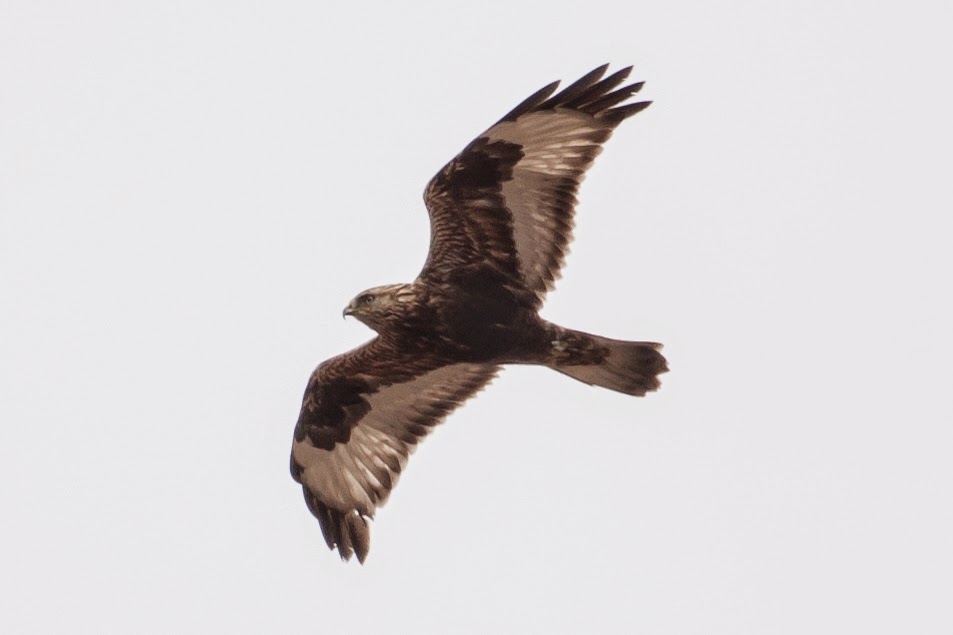
Rough-legged Hawk from HMANA ID Workshop 2015 - Luke Tiller
As well as working on identification of raptors we will focus, where possible, on aging and sexing birds as well as discussing subspecies and plumage types. As well as being instructional tour guides Frank Nicoletti and Luke Tiller pride themselves on providing a fun and relaxed atmosphere conducive to learning about identifying hawks in flight. Visits to the BBRR banding stations will allow us to get up close and personal with a number of raptors and study some key identifiers in hand. 

Check out these incredible days from tours past: This one included 5000 raptors including 46 Rough-legged Hawks and two dark morph Swainson’s Hawks (hawkcount report here), and this one almost 5000 raptors including a sweep of all possible buteos: 67 Rough-legged Hawks, Swainson’s Hawk, Black Vulture, Krider’s and dark Red-tailed Hawks (hawkcount report here). 


Saw-whet Owl from HMANA ID Workshop 2014 - Luke Tiller
This year the tour is pushed back to a slightly later start date. This means that we have a better chance of encountering one of those big Broad-winged Hawk days that Braddock Bay is known for. You can read tour leader Luke Tiller’s write up of a Braddock Bay flight that fell into this tours time frame in a previous season on his blog (here), and if the birding gods really smile upon us there is always the chance of something like this 37K raptor flight being  repeated(read about it on Luke's blog here).

Frank and Luke have both counted at Braddock Bay and have intimate knowledge of the region and the weather systems which makes sure that the group gets absolutely the best experience on any specific day. When flight conditions are not optimal we will visit places like Montezuma NWR, a great site for raptors and more,
 to see where much of the work was undertaken to reintroduce Bald Eagles to New York State and beyond.


2014 HMANA ID Workshop at Braddock Bay - Luke Tiller
As well as diurnal raptors we will be looking out for owls, visiting the BBRR Saw-whet banding operation, keeping our eyes peeled for a late Snowy Owl and checking out places where Short-eared Owl often gather to hunt. As well as all the raptors we will hopefully witness some of the incredible sky-blackening flights of passerines that can be seen along the Great Lakes, and get some instruction on IDing these birds too, as well as looking for specialist species like Trumpeter Swans, Sandhill Cranes and a wealth of wintering and migrant birds.

You can check out reports from previous year’s tours on our website and 
find out how to make bookings for the tour (here). You can check out a photo album of some of last years tour (here).

Friday, July 31, 2015

And they are off!

Clickers - Catherine Hamilton

It's started! Southbound migration. Here in Los Angeles those tiny terrors: Rufous Hummingbirds are back and bullying all and sundry at the feeders as they make their way south for the winter. Down along the LA River and out in the desert beyond the San Gabriel Mountains, shorebirds, terns and swallows are starting to pile up at the usual watery oases. Though just a trickle of landbirds so far, we aren't so far removed from the migrant flood.

Though most 'Fall' watches won't start up for a couple of weeks yet it was exciting to see the first flight of raptors reported on Hawkcount from Congaree Bluffs, SC (report here). It always seems weird to me to talk about Fall migration when most of my non-birding friends are still in the middle of their beach season. Of course in reality some birds are on the move most of the year and it always amuses me to think that while many hawkwatch sites are tallying southbound migration, up at the Braddock Bay Hawkwatch in NY (home of the HMANA Raptor ID Workshop) they are counting the northbound push of post breeding dispersal along the Great Lakes (read about the phenomenon here).

Red-tailed Hawk - Luke Tiller

Reading that report from South Carolina I find myself imagining the excitement of seeing those initial couple of migrant raptors breaking over the horizon, as well as enjoying the other soaring birds like Wood Storks and Anhingas as they float by. I wonder if I am the only one out there that gets a vicarious thrill from looking at the day's reports in Hawkcount and reading through the highs and lows of other peoples days out hawkwatching? Being in the Los Angeles Basin means that there is little in the way of any visual migration of raptors, or anything else for that matter, so being able to scan through the reports in the evening is about as close as I get.

I start with sites that I know well: either ones I have counted at or that I have visited. That way you know what you've missed by being miles away, or maybe just stuck in the office all day. As well as keeping up with known sites I also just enjoy looking through and reading the reports, appreciating the descriptions of the flights, the humor of the counters or even just sympathizing with the frustrations of a seasons developments. The real highlight for me though is to look at those sites with mind-boggling flights in Texas, Mexico and Panama and try to imagine the panic, joy and insanity a day with two million raptors might cause (Hawkcount report for Cerro Ancon, Panama here).

Braddock Bay Hawkwatchers - Luke Tiller

Am I alone in this? Or are there other online hawkwatchers enjoying the seasons flight from the comfort of their own office? Of course I have to say that being there for the flights would be better, but when you can't, at least for me, there is always Hawkcount! Maybe I should start a hawkwatchers anonymous for those of us deprived of the real thing by location, work or whatever else in life is getting in the way?


Monday, April 20, 2015

HMANA Raptor ID Workshop 2015 report

HMANA Workshop at Braddock Bay
HMANA’s raptor ID workshop is held in early April for a few very good reasons: Spring migration is much more compact than Fall which means seeing a good variety of different species over a week is much more likely than in say September. Early April specifically also gives you a great chance of seeing both adult and juvenile birds of many species and the end date of the tour also means that we have a great chance of running into the first Broad-winged Hawks of the season.

With all that taken into consideration the weather in Western New York in early April is, shall we say, temperamental at best. It helps that workshop leaders Frank Nicoletti and I both have a number of seasons experience counting at Braddock and have a pretty good feel for where might be good on what days depending on the forecast. Monday the 6th of April wasn’t promising much at Braddock or Derby Hill but the weather forecast to our west looked enticing enough that even with a late start to the day (to allow for arrivals from Vermont and sleep ins from California) we decided to roll the dice and head the hour and a half west for a ‘lifer’ hawkwatch for all concerned: Hamburg.  

Just south of Buffalo we arrived to find the Hamburg watch tallying a nice little flight of Red-shouldered Hawks, including a good number of adults. We also got treated to a few Ospreys, some Red-tailed Hawks (including a good number of heavily marked birds) and got to compare a few accipiters. The volunteer crew there made us feel very welcome and it was great to run into old friends (Alec Humann and Rick Bacher)  and make some new ones (counter Mike Zebehazy). They ended their day with almost 1500 birds, a nice count by anyone’s standards. We also ran into a couple of nice species for the trip including both Vesper and Field Sparrows and a beautiful wintering Red-headed Woodpecker. The days flight details (here). 

Osprey - Luke Tiller
The next two days (Tuesday 7th and Wednesday 8th) weren’t looking too promising for much in the way of raptor flight, but we kept our spirits up by exploring some of the other birding opportunities the region has to offer. We had soon swept up a nice array of waterfowl including a rare Tufted Duck in Ithaca and explored the myriad of open country habitats that make Montezuma NWR such a jewel of the New York birding scene. Montezuma is also the site where much of the reintroduction of Bald Eagles to the state was done and is still a popular nesting area for these birds. As well as some nice views and photo ops of the Bald Eagles we managed to dig up a few interesting gulls: Glaucous, Lesser Black-backed and Kumlien’s/Iceland and some cool waterfowl like Trumpeter Swans and Snow Geese.

The promise of a decent southeast winds and perhaps a flight Thursday saw us up at 5:30am and winging our way two hours east from our base in Rochester to Mexico, New York and the Derby Hill Hawkwatch. As we started to pull up to the site Frank and I already had a good feeling, the winds were right and clouds of blackbirds and American Robins were winging their way over the site. This is what it’s all about as far as I am concerned - the majesty and magic of migration. In the mix were Snow Buntings, Yellow-bellied Sapsuckers, Common Redpolls and Rusty Blackbirds aplenty and after a couple of hours the raptors began to pick up. 

The great thing about good flights at Derby is that when the winds are right the birds are almost directly over your head. This makes for a great learning experience. Derby is also kind enough to provide you with a set of numbered posts to help you describe where on the horizon a bird may be found (something for more watches to consider surely?).

Raptor highlights of the day included killer views of multiple Rough-legged Hawks and one very accommodating Golden Eagle that came right past us. We owed a big thanks to the whole Derby Hill crew for such a warm welcome, they really went all out to accommodate the needs of the group! Details of the days flight (here).

Rough-legged Hawk - Luke Tiller
Friday saw us with something of a conundrum, initially forecasts had shown potential for another good day at Derby and a day at Braddock that could be great or dismal depending on how long the rain held off. A late change to the forecast that showed potential for rain at Derby had us second guessing the two hour drive out there and back and instead focussing our energies back on Braddock Bay. 

We pulled up in the morning at Braddock Bay’s renowned West Spit to be greeted by both a light adult male Rough-legged Hawk and a Alfred Hitchcockesque flight of more blackbirds and robins. We knew we’d made a good call. Again there was a mix of goodies in the passerine flight including an impressive number of Northern Flickers, a Wilson’s Snipe and a few Purple Finches. The excitement was rapidly building but so were the clouds and after an hour or so of mainly passerine flight the skies opened and torrents of rain poured down - the perfect time to go replenish our caffeine at Tim Hortons. As skies lightened again we headed back to West Spit and the flight started up again with a bang as a juvenile Northern Goshawk bustled across the tree line in front of us giving great views.

The winds on the day really started to pick up in the late morning and we found ourselves moving in order to stay in touch with a flight that was pushing inland - not through wind direction but from the birds desire to stay away from the potential danger of the water. From our new sheltered spot we managed to pick up the two incredible highlights of the day: two adult dark Swanson’s Hawks! This was a repeat of last year’s amazing sightings but instead of being spread over two days, this took place on one.

The push of raptors was both exciting and educational - allowing great comparisons between species - even such unexpected ones as Rough-legged and Swainson’s Hawk. The raptors eventually petered out late in the day, but that just gave us the chance to stop in at Owl Woods to find a cute little Northern Saw-whet Owl. An incredible day - even more so given the early week forecast! Flight details (here). 

Northern Saw-whet Owl - Luke Tiller
The next two days saw the group back at Braddock Bay. Saturday carried the responsibility of heading up the Braddock Bay/HMANA Raptorthon event (details here).  Over the day the group and leaders tallied a highly respectable 14 species of raptors (including the tour’s only Peregrine Falcon and the season’s first Broad-winged Hawks) and 75 species of birds in total including both Long-eared Owl and a flyby Glaucous Gull! The final evening together as a group was spent sharing stories of the week and a few good local beers at the Old Toad Pub.

Sunday morning saw us again pick up a small but nicely mixed flight of passerines and raptors before long journeys home dragged participants reluctantly to the airport or to their awaiting cars. After a less than auspicious weather forecast at the beginning of the week it had turned into a great week with incredible and memorable passerine and raptor flights enjoyed, great learning experiences shared, and new friendships made. Over the week the group had tallied flights with almost 10,000 raptors of 16 different species and 124 species of birds overall including the Tufted Duck which was a life or North American bird for almost all concerned. I can’t wait to do it all again next year. Watch the HMANA website for upcoming details (events page here).

Saturday, July 12, 2014

Tour Report: HMANA Raptor ID Workshop 2014


Sharp-shinned Hawk - Catherine Hamilton
 Seven days on the Great Lakes plus a great week of weather divided by two expert hawkwatchers equals 10,928 diurnal raptors of fifteen different species! This is the story of HMANA’s 2014 Raptor ID Workshop.

Held between April 6 and April 12, the workshop assembled participants from the far flung corners of the United States in order to witness the diversity of raptor migration around the Great Lakes and to hone their proficiency as hawkwatchers. A major draw was the rare opportunity to spend a week learning from perhaps one of the most accomplished raptor experts in the country: Frank Nicoletti. Across the board, by the end of an unbelievable week of hawkwatching, everyone’s skills had been sharpened, friendships had been made an incredible number of raptors had been tallied.

Tired but happy hawkwatchers - Catherine Hamilton
In all, over the week, we totaled 135 species of birds. Highlights included: two stunning adult dark Swainson’s Hawks that graced Braddock Bay on back to back days, a Black Vulture - in a down season for them, good numbers and great views of Golden Eagles -especially at Derby Hill. We were also treated to a variety of flavors of Red-tailed Hawks: Dark/rufous morph adults, a Krider’s-like adult (are there many really pure ones left?) and plenty that fitted the seemingly refashionable albieticola subspecies. Rough-legged Hawks of all ages and sexes also put on a great show too, which is always a treat.

Among the non-raptors bugling Sandhill Cranes passed over the watch, we enjoyed the haunting calls of Common Loons from the lake, a collection of rare King Eiders on the bay, Red-headed Woodpeckers foraging at our feet, Purple Martins, Snowy Owls, Lapland Longspurs, Saw-whet Owls, Snow Buntings, Long and Short-eared Owls, Northern Shrike: the list goes on and on and on.

You can see details for the 2015 Workshop on the HMANA Website (here). We hope to see you there.

2014 participants - Catherine Hamilton

Sunday, February 2, 2014

HMANA 40th Anniversary Conference 2014 - Booking now!

Conference Logo - Tiffany DeRidder
We are pleased to announce that booking has now gone live for the HMANA 40th Anniversary Conference, which takes place between April 25-27th in Rochester, NY. You can read more details about the event on our newly launched conference website (link here), book your conference places online (here) or print off a booking form if you wish to send in a booking form with check (PDF here). 

The conference page has lots of excellent information about scheduling, speakers, field trips, lodging and more. Part of the appeal of the event has to be the incredible birding and raptor watching in the area and there is both a page with a map of places to visit (here) and details on the best local hawkwatching sites regionally (details here). These should really help you if you want to make even more of your visit to Western New York than just being there for the conference weekend.  

Attendees and speakers at the 2012 Conference - Julie Brown
As noted in a previous blog post, April 27th is a special day in Braddock Bay hawkwatching history as it is the day that our two record flights occurred in 1987 (hawkcount stats here) and 2011 (hawkcount stats here). Coincidentally the two official counters on that day are the two leaders combining to lead the HMANA Raptor Identification Workshop that will be taking place at Braddock Bay earlier in the month (details here). You can read my recollection of the 2011 flight on my blog (here); I think it nicely captures the excitement of the day.

The event will include tours of BBBO's (songbird) and BBRR’s (raptor) banding stations for those what to get to grips up close and personal with some raptors. Talks by experts in their fields, field trips, panel discussions on tricky raptor ID's, talks on advances in raptor migration tracking, practical advice on how your organization can create excellent educational programming as well as keynote talks from Richard Crossley (of Raptor ID Guide fame) and  Keith Bildstein (Sarkis Acopian Director of Conservation Science at Hawk Mountain Sanctuary).

Braddock Bay Hawkwatch - Luke Tiller
We are adding to the line up regularly on a regular basis and will be posting more exciting details for the event as they become available. To get an idea of what is in the pipeline keep watching this blog and keep an eye on the conference page. To take make sure that you take advantage of our Early Bird Booking you will need to make sure your booking is with us by April 1st.

It's a great opportunity to get together with hawkwatching aficionados and professionals from across the country and beyond. We look forward to seeing you in Rochester in April!


Tuesday, January 21, 2014

Raptor Bytes - hawkwatching morsels from around the web

Battling Bald Eagles - Steve Beal
Not sure why but these raptor notes seem to be taking on a somewhat themed feel to them. Let's just roll with it shall we?

Eagle Festivals
Mid-winter can be tough on your average raptor enthusiast what with the beginning of spring migration still over a month away. Though there’s winter bird surveys to do (link here), looking for something to really entertain the less fanatical birders in your clan isn’t always as easy. That’s why when I lived in New England I always looked forward to the area's various Eagle Festivals. Even as a hard bitten hawkcounter that has racked up daily flights of almost 100 eagles at Braddock Bay (hawkcount link), it’s hard not to still get excited by any encounter with a Bald Eagle. As anyone who has stood at a hawkwatch with a group of kids, or adults, knows, just one eagle can inspire game changing awe, so when you get the opportunity to share a bunch of them with other people you have to grab it.

Personally I worked on the Connecticut Audubon Eagle Festival in Essex on the Connecticut River for a couple of years and it was quite simply amazing. Though they stopped running the festival a few years back, they still run the eagle viewing boats (details here), and if you've never viewed Bald Eagles from a boat you haven’t lived in my honest opinion! There are also excellent events run on the Hudson River near Croton (details here) and on the Merrimack River in Newburyport and Amesbury (details here). 

What are your favorite winter raptor events? Share them in the comments section or on the link from our facebook page.

Bald Eagle - Steve Beal
Eagle Myths?
I'm sure you've all heard the story that Benjamin Franklin proposed that the Wild Turkey should be the national symbol rather than the Bald Eagle. The truth of the matter is he really didn't. What he did do was complain in a private letter to his daughter, after the eagle had been chosen as the national symbol, that veterans' organizations might be better off using the turkey rather than the eagle (a symbol often used by European monarchies) for their organizations symbols (more here). Thanks to Rick Wright for steering me towards this, his blog has lots of fascinating posts about birds including things like 'Are Bald Eagles really Bald' (link here)!

Eagles in North American Birds
The most recent North American Birds, which is published by the American Birding Association (website here) and available to members for an additional subscription, has an excellent article (here) concerning a possible White-tailed Eagle that was reported from late April at Derby Hill in 1995. Though rejected by the state rare records committee, the sighting has been included in a number of publications on raptors. This most recent paper reevaluates the report referencing important developments in White-tailed Eagle identification. It's a fascinating article and one that is well worth a read. You can also read the original NYSARC (New York State Avian Records Committee) reasons for rejecting the report on their website (here). Worth noting that Derby is one of the sites closest to Braddock Bay, will be one of the conference field trips, and the date almost corresponds to our 2014 conference date (details here)! Not sure we can promise you a repeat of a rarity of that magnitude, but it does show the incredible potential of hawkwatches in the region.


Wild Russian Eagles
Talking of Eurasian eagles, I wonder if anyone else has been catching the rather excellent Wild Russia documentary series that is being aired by Animal Planet here in the US. The Kamchatka episode had some amazing footage I rather enjoyed of dueling eagles. Though this clip doesn't show the best of it, the Golden Eagle tangling with the heftier Stellar’s Sea Eagles was incredible.

Thanks to Steven Beale for the use of the Bald Eagle shots. You can see more of his excellent work on his photo blog (here). 

Monday, December 23, 2013

HMANA CONFERENCE 2014 – 40 YEARS CONNECTING HAWKS AND PEOPLE

Braddock Bay Hawkwatch Platform - Luke Tiller
2014 sees HMANA's 40th anniversary, and to celebrate we are holding our 40th Anniversary Conference: 40 years connecting hawks and people. The event will take place between April 25 and 27 at Braddock Bay, which is just north of Rochester, New York.

I was lucky enough to be counting at Greenwich Connecticut when we held our last conference in 2012 and so got to experience all the fun of the event from my home turf. Most exciting to me about Greenwich was getting to make connections with other raptor aficionados from across the country and beyond. Two years later I am still in regular touch with many of those participants and attendees and consider them friends made. That's not to say that there wasn't plenty else to enjoy including: a wonderfully humorous and passionate talk by key note speaker Pete Dunne, lively panel discussions, fun field trips and fascinating lectures. Though it will be a tough event to top, I am convinced next years event is lining up to be even better.


The conference next April already boasts two excellent keynote speakers in Keith L. Bildstein and Richard Crossley. Keith is the Director of Conservation Science at Hawk Mountain and is renowned in the world of raptor conservation for his wide ranging research and accessible publications. As well as being the author of the Crossley ID Guide series (including this year's well received Crossley ID Guide: Raptors), Richards driving passion is to promote conservation by popularizing birding and I say what better way to popularize birding than to promote the coolest birds going: hawks, falcons and eagles!


Happy Hawkwatchers at Braddock Bay - Luke Tiller
As well as the keynote speakers there will be panel discussions on a variety of relevant topics, lectures on everything from how the latest technology is informing our understanding of raptor migration to how to develop outstanding educational programming. Apart from the talks, there will be workshops on raptor photography from some of the leading exponents in the field, classes on raptor identification from the experts out on the hawkwatch platform as well as field trips to local birding hotspots. There will also be additional more extensive field trips out to nearby birding hotspots and points of interest including the Roger Tory Peterson Institute, Derby Hill and other nationally renowned sites like Montezuma NWR. All these events will be lead by expert local guides and it will also be a chance to meet the guides who lead for HMANA's national and international tour programs.

The festival also takes place the same weekend as our host organizations 'Bird of Prey Days' event, so other events over the weekend will include tours of the legendary Braddock Bay Raptor Research (website here) and Braddock Bay Bird Observatory’s (website here) banding stations, live bird of prey shows and opportunities to try out the latest optics and birding related products at the trade show among the myriad of other fun events.

The only way to count all the birds at Braddock Bay - Luke Tiller
If that wasn't enough to tempt you, the festival just happens to fall on the same magical date that has historically seen the two largest raptor flights in Braddock Bay Hawkwatches history: April 27th. Of course if we do have days either like this or like this it might be hard to drag yourself away from the hawkwatch platform to see all the other amazing events. If you can't imagine what counting a 40k bird flight is like, here is my write up of the big day on April 27th 2011 on my blog (here) which was also published in HMANA’s Hawk Migration Studies magazine.

Some more information about the event can be found on the HMANA website (here).  Bookings will go live from early January so look out for notices online, via email and in our forthcoming journal. I'm sure you are as excited as I am to get booking - look forward to seeing you all in Rochester in April!

Thursday, November 14, 2013

10 good reasons to join us for the HMANA Raptor ID Workshop at Braddock Bay

Red-shouldered Hawk - LukeTiller
HMANA Raptor ID Workshop at Braddock Bay, near Rochester, NY - April 6-12 2014

1/ You get to hone your raptor identification skills in a small group led by Frank Nicoletti, probably one of the most accomplished hawkwatchers anywhere on the planet.

2/ Early April is prime time at Braddock Bay to see the highest diversity of raptors in terms of species: with potential to see seventeen species of eagles, hawks, falcons and vultures. Perhaps almost as importantly the tours timing will also provide the greatest opportunity to grapple with aging, sexing and, where possible, even identifying birds to subspecies.

Merlin - Luke Tiller
3/ Tour timing is perfect to see some big movements of raptors as it falls squarely within the time period that often sees the kind of flight that produces one thousand Red-tailed Hawks, a four figure tree top flight of Sharp-shinned Hawks or more than five thousand Turkey Vultures. How does a day like this spent in one of the countries most knowledgeable raptor experts company take your fancy? Or maybe one like this or this? You can read about a past big day at Braddock Bay Hawkwatch that happened during the same time period on my blog (here).

4/ Between our base camp at Braddock Bay and a day trip or two, it will be great timing to see good numbers of some of North Americas most desirable raptor species such as Golden Eagle, Rough-legged Hawk and Northern Goshawk as well as other potentially locally interesting species such as Black Vulture and Swainson’s Hawk.

Common Redpoll - Luke Tiller
5/ In among the flying raptors there will be other great migratory birding to experience. All of this will allow us to hone our visible migration skills as well as our knowledge of flight calls. How do you separate a Snow Bunting from a Lapland Longspur? A flock of American Pipits from a flock of Horned Larks? The buzz of Pine Siskins from either goldfinch or redpoll? All of this is becoming part of being a well rounded hawkwatcher, and this HMANA Workshop will help you explore and develop these set of skills.

6/ The workshop will also guarantee you a week in the company of both fun and like minded people: what could be more entertaining than kicking back at a couple of the US’s finest spring raptor migration sites with a group of newly acquired friends?

Braddock Bay Hawkwatch - Luke Tiller
7/ As well as years of general experience, both tour leaders have counted at Braddock Bay specifically, so they know where and when to go in the area in order to ensure participants get the most out of the migratory experience and perhaps almost importantly the best places to go grab some fine BBQ and a great beer afterwards!

8/ Get excitingly up close and personal experience with raptors and other birds as we visit the hawk, owl and songbird banding projects that are undertaken in the area. These in hand views of raptors can be invaluable learning experiences.

Dark Rough-legged Hawk - BBRR
9/ Know that your participation will help support the conservation and research work that HMANA undertakes, help provide the resources they provide to counts across the country, as well as assist the important work undertaken by local non-profit organizations like BBRR that are funding the rapotor projects around the country which we all love so much.

10/ All this and you don’t even have to count one bird that is flying past you; well unless you really, really want to.

Monday, September 30, 2013

The Eagle has landed: 'southern' Bald Eagle dispersal in spring

Juvenile Bald Eagle - Joseph Stevenson
'Southern' Bald Eagle migration. It’s a phenomenon that spring hawkwatches, especially along the great lakes, look forward to for late season excitement. I distinctly remember my first major flight at Braddock on May 29th 2011 when an incredible 94 individual Bald Eagles soared past me on the day – including kettles of eagles up to nine strong and an hour where 63 birds were tallied.

Though even relatively recently I have had experienced hawkwatchers question me about the veracity of the phenomenon, it was back in the mid eighties that experienced hawkwatchers like Frank Nicoletti started to note the occurrence of these flights. As the story was related to me, during his first seasons tenure at Braddock Bay Frank noticed that a lot of the late season birds they were seeing looked like small (see Bergmann's rule), crisp and extensively dark hatch year birds – unlike the bleached and worn juveniles one would expect to see if they had hatched the previous year. Apparently he stated immediately that he believed these were hatch year birds from Florida and other Southern States.

Juvenile Bald Eagle - Joseph Stevenson
During an average season one can view this kind of flight reflected on the HMANA Hawkcount website in May at Braddock Bay (for example). In fact these flights can often be seen moving over watches into June after the official end to the season at places like Braddock and Derby Hill and those eagles can often make up a significant percentage of those days flights (example here). 

Personally, whilst counting at Braddock, I had noted up that some of the birds arriving with the Broad-wings in mid-April also appeared to have this smaller, darker, crisp appearance. It seemed to me impossible that these could be southern birds though just due to the early timing, but they sure looked right for them. That, however, would mean birds, just a couple of months out of the nest, had made it the 1000-1500 miles all the way from Southern Florida up to Rochester; it just seemed too incredible to imagine.

Juvenile Bald Eagle - Joseph Stevenson
A little research though seemed to back up the possibility, as according to the USFWS Bald Eagle egg-laying can begin during October. Given a four and a half month cycle until fledging and then a few extra weeks spent around the nest that would seem to point to the potential dispersal of these young eagles during late March. To witness this early breeding in action you can follow the nestcam of a Bald Eagle in Southwestern Florida (here), you can also see updates on their exceptionally popular facebook page (here). The feed starts in just a day or two on October 1st.

These theories at Braddock got the support of some hard evidence this year for the first time. On April 13th one of BBRR’s stalwart banders, Dan Niven, captured a Bald Eagle at the Braddock Bay Raptor Research main blind that was already sporting a band. This was exciting enough in and of itself, but when the report was received from the bird banding lab we discovered something incredible and important, that the bird had been banded as a hatch year bird on February 5th down in Florida (coincidentally enough by ex-BBRR bander John Newhouse). Here was definitive proof that birds that hatched that same year in Florida could make it up to Braddock Bay by mid-April as part of their dispersal.

'Southern' Bald Eagles had initially been believed to be a sedentary subspecies until banders in Florida started to actively band them. Returns of these bands showed that these birds were heading north for the summer. Check out this awesome article (here) from 1947 that Rick Wright brought to my attention after reading this post. Note firstly how far north these banded birds were recovered: PEI, New Brunswick and Nova Scotia and secondly, sadly, the number recovered dead after being shot (even though the Bald Eagle Protection Act had been passed in 1940).

Juvenile Bald Eagle - Joseph Stevenson
This northbound dispersal, to me, underlines the incredible feats these birds perform and just another reason to be in awe of them. If you want to come see some of these 'southern' Bald Eagles fly, come join The Hawk Migration Association of North America and Frank Nicoletti for their Raptor ID Workshop up at Braddock Bay in early April 2014 (link here) or for HMANA's 40th Anniversary Conference in the same location later in the month (link here).

Thanks to Joseph Stevenson for the photographs of the event.

Thursday, September 19, 2013

'Tails' from a Braddock Bay banding station....

Juvenile Red-tailed Hawk - Braddock Bay Raptor Research
Although Braddock Bay, the destination for the forthcoming HMANA Raptor ID Workshop (link here), is best known for spring migration and raptor banding it also annually tracks the movement of dispersing hawks in the late summer, when the Braddock Bay Raptor Research (website here) open their nets again to band mainly young Red-tailed Hawks. As a hawkwatcher, it has always amused me that whilst watching many birds heading south in fall Braddock Bay is still catching the northbound movements of these young birds.

Recently an incredible story of one of these juvenile Red-tailed Hawks reached us at Braddock Bay via Jeff Bouton. Back then he was a bander extraordinaire with Braddock Bay Raptor Research and Braddock Bay Bird Observatory though now he is probably best known to most of you as the birding expert at Leica Sport Optics. Anyway, all the way back on the 3rd of September 1991 Jeff banded a Red-tailed Hawk at Braddock Bay, as part of the annual late summer juvenile Red-tailed Hawk movement. Recently, 22 years later, Jeff received word that the band from that bird was recovered in Pennsylvania after the bird had been found dead. Though somewhat sad, for a hawk that is a pretty good run and in fact this makes it one of the 10 oldest wild Red-tailed Hawks on record. 
Juvenile Red-tailed Hawk - Jeff Bouton
Jeff noted in his message that the day they banded the bird was not a particularly exceptional day for raptors at Braddock as they had captured and banded a mere 10 Red-tailed Hawks. To me that seems pretty good, but then we are comparing it to the kind of days where well over 100 birds have been banded at the Braddock Bay stations. As Jeff noted in his message to BBRR though:  

"...One of those 10 birds however would turn out to be exceptional. One of the largest birds of the day, which took the largest band size acceptable for the species (7D), was just reported found dead near Marion Center, PA. This means the bird lived over 22 years in the wild and makes it the 10th oldest wild Red-tailed Hawk on record!"

Though the above photo of Jeff was taken at the time, it probably isn't of the bird in question as Jeff reckons it to be a little too small. To me it's incredible to imagine this tenacious bird staking out its territory and surviving quite so long in the wild. Out of interest Marion Center, PA is about 250 miles south from Braddock Bay so the bird obviously did a little more wandering before settling down. Data like this shows the continued value of raptor banding. The USGS page on Longevity Records for North American Birds provides a useful educational tool when people ask those inevitable 'how long do they live' type questions about raptors, or any other birds for that matter (visit their page here).

"Mr Grumpy Pants" - Luke Tiller
Coincidentally one of the oldest Red-tailed Hawks in captivity is held by Anne and Paul Schnell. Anne is co-director and heads up the banding efforts at Braddock Bay Raptor Research. Anne and her husband Paul have educational birds and Pauls birds are a major part of the BBRR's educational and outreach events. Their 35 year old Red-tailed Hawk, affectionately called 'Mr Grumpy Pants' still gets called in for publicity duty and my first season at Braddock Bay I ended up posing in the snow alongside Mr Grumpy Pants for the cover of the local newspaper. Grumpy was born in 1978 and is an imprint, as a result of being fed by hand once removed from his nest. As far as I can ascertain, the oldest recorded captive bird died at 36 and a 1/2 years

Thursday, March 22, 2012

It's Time for RAPTORTHON!


Spring has sprung, and it is time for another HMANA Raptorthon! Now in its third year, this fundraiser is fun and entertaining way to raise money and awareness for raptors and hawkwatching across North America. Some teams have already signed up and picked their dates for their big day. Consider forming a team of your own to support your local hawkwatch and HMANA.


This year my team, Braddock Bay Raptor Research (BBRR), will hold its Raptorthon on May 12, which falls during the latter part of the spring raptor migration. For the third spring in a row, we will attempt to count the most raptor species we can from the Braddock Bay hawkwatch, located on the southern shore of Lake Ontario. Last year BBRR earned the accomplishment of having counted the most raptor species out of all the teams that participated, and we hope to do it again! We were proud to have doubled our funds raised last year, and we were able to use the money to help build a new display board for our hawkwatch platform. This year our goal is to raise enough money to cover a sponsorship for our Hawkcount.org page, and to help cover our housing costs for our hawkwatcher.

Because the month of May is a great time to see Bald Eagles ring migration at Braddock Bay, this year’s Raptorthon event has taken on an eagle theme. BBRR will be holding several eagle related programs and activities for this “Eagle Day” including observation time with a live bald eagle named Liberty, who is an educational ambassador from the Institute for Environmental Learning in Hilton, NY. There will also be eagle crafts and activities for our younger visitors. Of course there will be hawkwatching, and there will also be a chance for people to “adopt” hawks that are banded at our raptor banding station.


There are many ways to conduct a Raptorthon, and you don’t need to be an experienced hawkwatcher or even have a favorite hawkwatch to do so. BBRR takes advantage of the fact that we conduct a spring hawk count and can utilize the beautiful Braddock Bay Park which is easily accessible to participants. Our goal is not only to raise much needed funds for our site and HMANA, but to also reach out to the community and share the enjoyment and importance of hawkwatching as a whole. A great thing about doing a Raptorthon is that you can create one to suit your needs. Visit HMANA’s website at http://hmana.org for Raptorthon ideas, or to make a pledge to support the team of your choice.

Daena Ford
Co-Director, Braddock Bay Raptor Research
Membership Secretary, Hawk Migration Association of North America

Thursday, March 18, 2010

How about those eagles?

Finally! The central and east coast weather systems have cleared, and the first decent flights of migrating hawks weren’t far behind. March 16 and 17 were the first good days for many spring hawkwatches.

West Skyline in Duluth counted (please sit down first) an amazing 679 bald eagles on March 16. Counter Karl Bardon reported the flight was very compacted with hourly counts of 218 from 12-1300 and 247 from 13-1400. Kettles of 30-40 eagles were reported. To make that sweet story even sweeter, their count of 30 Golden Eagles isthe  highest spring count for the site to date.

Red-tailed hawks generally posted good numbers elsewhere, with bald eagles also putting in a good show in a few other places. Derby Hill in New York found 156 Red-tails on March 17, and nearby Braddock Bay posted 100 on the 16th. The days were also good ones for variety at these New York Sites.

Even the sites that didn’t find great numbers of birds weren’t complaining about the weather.