Showing posts with label HMANA. Show all posts

Monday, September 19, 2016

HMANA Seeks Executive Director

The Hawk Migration Association of North America (HMANA) is seeking a dynamic, enthusiastic leader to become its first executive director.  If you are a proven fundraiser in a non-profit arena, preferably in an environmental field and with knowledge of raptors and their migrations, please consider applying for this unique opportunity.

Applications will be accepted until November 1, 2016.  The winning candidate will have an office in the Detroit River International Wildlife Refuge’s new visitor center near Gibraltar, Michigan, approximately 20 miles south of Detroit.  The visitor’s center will open in early 2017 and is located within a major flyway for southbound raptors.

We are looking for an experienced, outgoing individual with proven fundraising expertise and a track record of membership growth and volunteer engagement in a nonprofit organization. Position is funded for two years, and the incumbent is expected to work with the board of directors to seek funding to grow the organization and continue the position beyond 2018.  Benefits include health insurance stipend and vacation, among others.

For a full job description, visit http://www.hmana.org/executive-director-job-description/ .  To apply, please submit cover letter, resume, and at least three professional references to: director@hmana.org . No phone calls or agency submissions, please.

HMANA is a membership-based, citizen-science and professional organization of more than 200 raptor migration monitoring sites in North America. Founded in 1974, we maintain the largest repository of raptor migration counts in the world through HawkCount.  HMANA partners with three other organizations as part of the Raptor Population Index Project (http://rpi-project.org\) to analyze and disseminate information on regional and continental raptor population trends based on migration count data. The organization maintains a variety of other research programs and fundraising efforts (http://www.hmana.org/).

Tuesday, March 22, 2016

More HawkCount reviewers needed!

The HMANA Data Committee and Board have re-initiated a review of HawkCount data entry in an effort to reduce errors and encourage documentation for rare species observations. Prior to the shift to digital data entry, HawkCount paper forms were previously reviewed for accuracy.
The reviewers listed below by state, province or region have kindly volunteered to serve in this capacity starting in spring 2016. Because more HawkCount sites operate during the fall migration, we will be expanding this review process and will need additional volunteers starting in late summer 2016. Contact Gerald J. Niemi (gniemi@umn.edu) if interested.  

Reviewer                            Count Area(s)   
Zach Smith                        Maine, New Hampshire, Vermont, 
                                              New Brunswick, Quebec
Paul Roberts                      Connecticut, Massachusetts
Andy Mason                      New York
Laurie Goodrich                Pennsylvania
Holly Merker
Tom Reed                           Delaware, Maryland, 
                                              New Jersey, North Carolina, Virginia
John Barker                        Eastern Ontario
Markus Mika                     Arkansas, Manitoba, Michigan, Minnesota, 
                                              Western Ontario, Wisconsin
Neil Paprocki                     Alaska, Arizona, Colorado
Alan Fish                           California
Arthur Green                      Montana, Texas, Mexico, Central 
                                              and South America 

Wednesday, December 16, 2015

Hawk Watch Fund - Help your watchsite be all it can be!

2013 Hawk Watch Fund winners display a new interpretive sign at Rockfish Gap Hawk Watch, VA.
If you coordinate a hawk watch site, chances are you have ideas milling around your head on how to make improvements. Maybe you have hopes for hiring an educator, a new tally board or platform to see over all those trees. I know I often brainstorm about all the great things I’d like to offer to our thousands of visitors each fall at the Pack Monadnock Hawk Watch in NH. New raptor silhouettes for education programs or an interpretive sign labeling all the mountains in the landscape would be great!

Whether sites are managed by state agency, non-profit or one or more raptor enthusiasts, we all seem to share the same challenge…finding ways to sustain our counts. We all seem to be struggling financially in one way or another. That is why HMANA created the Hawk Watch Fund to offer support to the hawk watching community. The purpose of this Fund is to provide grants through the production of educational materials and displays, construction and maintenance of viewing platforms, hiring of hawk watchers, or purchase of equipment. The grants are made through a competitive application process and judged annually by a committee appointed by HMANA.\

Last year’s winner was Hawk Ridge Bird Observatory in Duluth, MN. They received $1,000 in support of a Migration Monitoring Count Traineeship last fall which was a great success.

Applications may be submitted between December 1, 2015-February 15, 2016 and grants will be announced and applicants informed by April 1, 2016.


Please see www.hmana.org for guidelines and application.

Good luck!


Tuesday, September 29, 2015

Monitoring Count Traineeship a Great Success!


The Hawk Ridge count team: Alex Lamoreaux, counter; Karl Bardon, count director and Kaija Gahm, count trainee

When Hawk Ridge Observatory was awarded HMANA’s 2015 Hawk Watch Fund to fund a migration monitoring “count” traineeship, we were excited to hear more about it.

Well it’s mid-season and it seems the position has been wildly successful so far. This year’s count trainee, Kaija Gahm, Kaija is an enthusiastic and accomplished young woman who is taking a "gap year" between high school and going off to college at Yale. Among her other accomplishments, she has been a participant in the Cornell Lab of Ornithology "Young Birders Event"; she has won the Massachusetts (overall & Wildlife categories) and national (Wildlife category) Envirothon; and she has been an active participant in E-bird and the Massachusetts Audubon Bird-a-thon for several years throughout high school.

Kaija has been involved in some fantastic days of counting at Hawk Ridge, including a day of 90,000+ songbirds on September 1. Karen Stubenvoll, Hawk Ridge Board Chair is thrilled with Kaija. “It has really enhanced our count by having her here, and we are so happy to be training the next generation.”

The goal of the count traineeship is to provide a unique, hands-on, professional training opportunity for those interested in learning the skills to conduct migration monitoring research. The trainee learns identification of birds by both sight and sound for raptors and non-raptors, data collection, data entry, public relations with visitors, and other valuable research tools.   

Here is a video clip of Kaija in action with hawk counter Alex Lamoreaux from the Duluth News Tribune.
The duty of a counter at Hawk Ridge: http://www.duluthnewstribune.com/video/4480074064001

Kaija scanning the sky for raptors at Hawk Ridge
Hearing this story makes us very happy at HMANA. This is what the Hawk Watch Fund is all about! We offer grants each year to watch sites in the HawkCount.org monitoring network with the purpose of providing grants to assist watch sites looking for support whether it’s educational materials and displays, construction and maintenance of viewing platforms, hiring hawk watchers, or purchase of equipment. Funding comes from proceeds of HMANA’s annual spring Raptorthon and from direct donations to the Fund.

Sites may apply from December 1-February 15 and awards are chosen April 1. For more information on how to apply, please visit www.hmana.org. 

All photos by Karen Stubenvoll


Monday, August 24, 2015

Fall Hawkwatching Basics: Where and When

Hawkwatching - Braddock Bay, NY
As a seasoned hawkwatcher this is a conversation that I have had sadly all too often: on a deathly slow day someone shows up at the watch and asks ‘how is it going’. After you’ve relayed the bad news about winds from the wrong direction and a band of blocking rain to the north they say something like “but it looked like you had a great day yesterday”.

A quote I once read started ‘yesterday is a memory, tomorrow is a dream…’ and that’s the truth about hawkwatching. To get the most out of the hawkwatching experience you need to become something of an amateur meteorologist, or at least look at the weather forecast once in a while. Like much birding during migration, weather is going to play a key part in your success. Though I have been relayed charming stories about the early years of hawkwatching, that were spent looking for birds on previously set dates each fall regardless of the fact that it was perhaps pouring with rain that day, we now understand that there is a slightly more scientific approach to actually seeing some birds at a hawkwatch.
Hawkwatching - Texas
The rest of the quote I referenced above runs ‘…today is a gift.’, so even if you find yourself at the watch on one of those slow days don’t despair. You might still make the best of it by learning some stuff from the hawkwatcher or others there at the watch. It’s generally much easier to glean some information from hawkwatchers on slow days, when they will be thankful for some company, than on madcap days when they are trying to keep up with a huge flight. On those days it might be best advised to not talk to them at all ;) Also even on the slower days, you never know what might show up. I always say it only takes one bird to dramatically change the complexion of how a day’s birding went.

To cover the basics of Fall migration, though each watch will have its own ideal wind and weather conditions, to generalize you are looking to head out on days with northerly winds (blowing from the north – sometimes that isn’t clear to people) to bring birds southwards and hopefully past your watch. Sometimes a watch might do better on northwest winds sometimes northeast depending on the location. In fact, once you become more expert in meteorological matters and your local watches, sometimes the direction and strength winds are blowing might sway which local watch you decide to visit on a certain day. You may also want to check whether rain might dampen the flight. That said, rain is not always a reason not to head out, I have sometimes had some good days watching between light showers and often huge flights can be formed ahead of a storm system.  
Hawkwatching - Quaker Ridge, CT
Weather discussions perhaps assumes that you even know where to go looking for a regularly staffed hawkwatch site? To find a local watch site you can check out the hawkcount website map and click the individual states to find out where your local counts are (link here). Some counts happen in spring, some counts are in fall and some are both. You can click on the individual site link to find out general information about each site. If you click the “migration timing” tab you can get a feel for the usual peaks and troughs of the sites season and by clicking “latest count data” you can usually gauge how regularly the watch is covered.

If you want to find out what the forecast for the hawk flight is like for the next day you can sometimes read this on the individual daily reports from reporting sites (example here). These individual reports are viewable on the front page on Hawkcount (link here). As I write this post it’s currently pretty early on in the season so only a handful of sites are regularly reporting right now. Having had to write those forecasts myself and knowing how unlikely they are to be 100% accurate I understand why counters sometimes feel reluctant to complete that section, but they are more likely to when it at least looks promising the following day.
Hawkwatching - Israel
Keep an eye on the HMANA blog through the fall season, as we will be posting more articles aimed at cluing in beginner and intermediate level hawkwatchers on how to get the most out of the hawkwatching experience over the next few weeks.

A version of this piece was originally posted on Luke Tiller's blog Underclearskies (link here).

Saturday, August 8, 2015

Looking for a few good board members


Serving as a director on HMANA’s board of directors is fun, rewarding and an important way to help assure raptors and migration study continues into the future.  Now is the time for HMANA members and prospective members to get involved in board activities for 2016.     

HMANA’s board is comprised of nine elected and up to eight appointed directors.  Elected directors serve three-year terms; board-appointed directors serve one-, two- or three-year terms.  Board members are expected to participate in a majority of the board’s monthly meetings as a minimum commitment.  Most board members also serve actively on one or more of HMANA’s 14 committees, whose work includes overseeing HMANA award programs, directing HMANA’s communications, managing its endowment fund, creating and implementing development opportunities, creating raptor adventure tours, supporting and improving HawkCount and the use and archiving of data contributed by hawk watch sites, monitoring and working on conservation issues and assuring appropriate governance practices. 

HMANA currently is preparing the 2015 election ballot of HMANA members to serve on the board of directors.  The election occurs in September, when the board expects to fill at least three positions by election or appointment.  Any HMANA member interested in serving on the board should contact Gil Randell, whose duties as secretary include coordinating the election and appointment process (janngil@fairpoint.net).  HMANA members are also encouraged to suggest candidates to Gil.

This is an exciting time for HMANA with the hiring of its first full-time executive director anticipated within the next two years along with the opening of our new office.  Work as a director on the HMANA board has always been fun and rewarding, and is becoming even richer and more interesting as the organization embarks on this new stage of its development.   

If you are not quite ready for a board term, stay tuned for a chance to serve on one of HMANA’s committees.  Look for information about how to become active on a committee in October.
 
Get involved!  

Monday, April 20, 2015

HMANA Raptor ID Workshop 2015 report

HMANA Workshop at Braddock Bay
HMANA’s raptor ID workshop is held in early April for a few very good reasons: Spring migration is much more compact than Fall which means seeing a good variety of different species over a week is much more likely than in say September. Early April specifically also gives you a great chance of seeing both adult and juvenile birds of many species and the end date of the tour also means that we have a great chance of running into the first Broad-winged Hawks of the season.

With all that taken into consideration the weather in Western New York in early April is, shall we say, temperamental at best. It helps that workshop leaders Frank Nicoletti and I both have a number of seasons experience counting at Braddock and have a pretty good feel for where might be good on what days depending on the forecast. Monday the 6th of April wasn’t promising much at Braddock or Derby Hill but the weather forecast to our west looked enticing enough that even with a late start to the day (to allow for arrivals from Vermont and sleep ins from California) we decided to roll the dice and head the hour and a half west for a ‘lifer’ hawkwatch for all concerned: Hamburg.  

Just south of Buffalo we arrived to find the Hamburg watch tallying a nice little flight of Red-shouldered Hawks, including a good number of adults. We also got treated to a few Ospreys, some Red-tailed Hawks (including a good number of heavily marked birds) and got to compare a few accipiters. The volunteer crew there made us feel very welcome and it was great to run into old friends (Alec Humann and Rick Bacher)  and make some new ones (counter Mike Zebehazy). They ended their day with almost 1500 birds, a nice count by anyone’s standards. We also ran into a couple of nice species for the trip including both Vesper and Field Sparrows and a beautiful wintering Red-headed Woodpecker. The days flight details (here). 

Osprey - Luke Tiller
The next two days (Tuesday 7th and Wednesday 8th) weren’t looking too promising for much in the way of raptor flight, but we kept our spirits up by exploring some of the other birding opportunities the region has to offer. We had soon swept up a nice array of waterfowl including a rare Tufted Duck in Ithaca and explored the myriad of open country habitats that make Montezuma NWR such a jewel of the New York birding scene. Montezuma is also the site where much of the reintroduction of Bald Eagles to the state was done and is still a popular nesting area for these birds. As well as some nice views and photo ops of the Bald Eagles we managed to dig up a few interesting gulls: Glaucous, Lesser Black-backed and Kumlien’s/Iceland and some cool waterfowl like Trumpeter Swans and Snow Geese.

The promise of a decent southeast winds and perhaps a flight Thursday saw us up at 5:30am and winging our way two hours east from our base in Rochester to Mexico, New York and the Derby Hill Hawkwatch. As we started to pull up to the site Frank and I already had a good feeling, the winds were right and clouds of blackbirds and American Robins were winging their way over the site. This is what it’s all about as far as I am concerned - the majesty and magic of migration. In the mix were Snow Buntings, Yellow-bellied Sapsuckers, Common Redpolls and Rusty Blackbirds aplenty and after a couple of hours the raptors began to pick up. 

The great thing about good flights at Derby is that when the winds are right the birds are almost directly over your head. This makes for a great learning experience. Derby is also kind enough to provide you with a set of numbered posts to help you describe where on the horizon a bird may be found (something for more watches to consider surely?).

Raptor highlights of the day included killer views of multiple Rough-legged Hawks and one very accommodating Golden Eagle that came right past us. We owed a big thanks to the whole Derby Hill crew for such a warm welcome, they really went all out to accommodate the needs of the group! Details of the days flight (here).

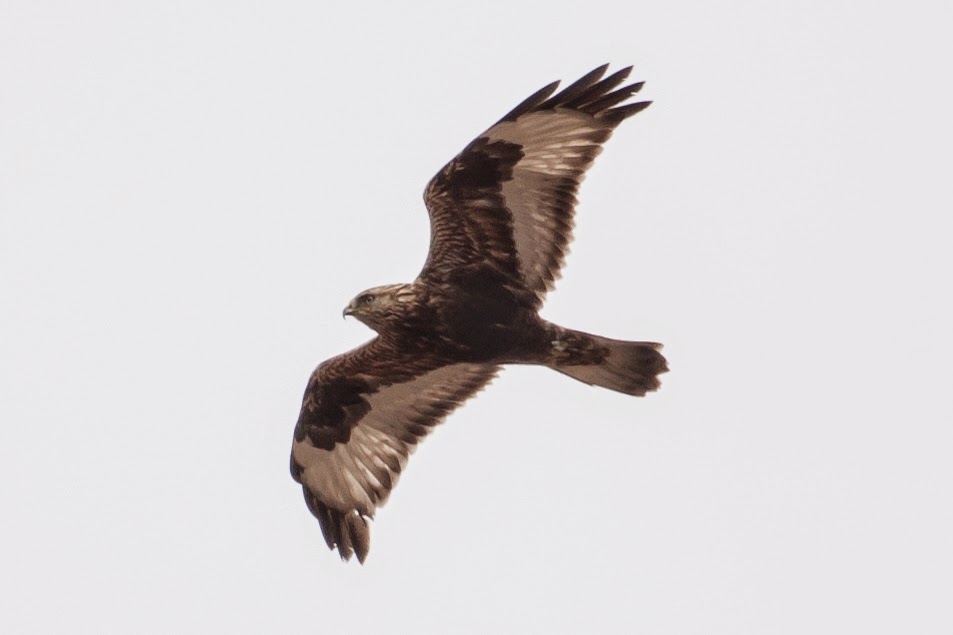
Rough-legged Hawk - Luke Tiller
Friday saw us with something of a conundrum, initially forecasts had shown potential for another good day at Derby and a day at Braddock that could be great or dismal depending on how long the rain held off. A late change to the forecast that showed potential for rain at Derby had us second guessing the two hour drive out there and back and instead focussing our energies back on Braddock Bay. 

We pulled up in the morning at Braddock Bay’s renowned West Spit to be greeted by both a light adult male Rough-legged Hawk and a Alfred Hitchcockesque flight of more blackbirds and robins. We knew we’d made a good call. Again there was a mix of goodies in the passerine flight including an impressive number of Northern Flickers, a Wilson’s Snipe and a few Purple Finches. The excitement was rapidly building but so were the clouds and after an hour or so of mainly passerine flight the skies opened and torrents of rain poured down - the perfect time to go replenish our caffeine at Tim Hortons. As skies lightened again we headed back to West Spit and the flight started up again with a bang as a juvenile Northern Goshawk bustled across the tree line in front of us giving great views.

The winds on the day really started to pick up in the late morning and we found ourselves moving in order to stay in touch with a flight that was pushing inland - not through wind direction but from the birds desire to stay away from the potential danger of the water. From our new sheltered spot we managed to pick up the two incredible highlights of the day: two adult dark Swanson’s Hawks! This was a repeat of last year’s amazing sightings but instead of being spread over two days, this took place on one.

The push of raptors was both exciting and educational - allowing great comparisons between species - even such unexpected ones as Rough-legged and Swainson’s Hawk. The raptors eventually petered out late in the day, but that just gave us the chance to stop in at Owl Woods to find a cute little Northern Saw-whet Owl. An incredible day - even more so given the early week forecast! Flight details (here). 

Northern Saw-whet Owl - Luke Tiller
The next two days saw the group back at Braddock Bay. Saturday carried the responsibility of heading up the Braddock Bay/HMANA Raptorthon event (details here).  Over the day the group and leaders tallied a highly respectable 14 species of raptors (including the tour’s only Peregrine Falcon and the season’s first Broad-winged Hawks) and 75 species of birds in total including both Long-eared Owl and a flyby Glaucous Gull! The final evening together as a group was spent sharing stories of the week and a few good local beers at the Old Toad Pub.

Sunday morning saw us again pick up a small but nicely mixed flight of passerines and raptors before long journeys home dragged participants reluctantly to the airport or to their awaiting cars. After a less than auspicious weather forecast at the beginning of the week it had turned into a great week with incredible and memorable passerine and raptor flights enjoyed, great learning experiences shared, and new friendships made. Over the week the group had tallied flights with almost 10,000 raptors of 16 different species and 124 species of birds overall including the Tufted Duck which was a life or North American bird for almost all concerned. I can’t wait to do it all again next year. Watch the HMANA website for upcoming details (events page here).

Monday, September 8, 2014

Tales from the platform

Red-tailed Hawk - Luke Tiller
Hawkcount does an amazing job helping us tally the migration of hawks across the Americas. I can safely say that without being accused of being biased as I have nothing to do with its design or upkeep here at HMANA. This month is also Hawkcount Now and Forever fundraising month (which you can read more about here). One of my most recent discoveries is how easy Hawkcount's simple interface makes it to update via your smartphone while you are in the field - I wish I'd noted that when I was actively counting this season!  As someone who uses it on a regular basis as a hawkwatcher and trawls through it to write up flyway accounts it does have some limitations when it comes to capturing some of the more esoteric moments of a season in a way that is readily accessible to those scanning through the reports.

Bobcat @ Quaker Ridge - Shaun Martin
A cursory scan of the front page of Hawkcount does allow readers to pick up good rare raptors like the pair of Mississippi  Kites I had one day at Quaker Ridge, CT (blog post here) or the Gyrfalcon at Braddock Bay, NY, but what it captures less effectively is the dark Broad-winged Hawk or completely white Turkey Vulture (picture here) I had at Braddock. A cursory scan of the Hawkcount front page gives you the numbers from a days count, but no real feel for a day that over a thousand Broad-winged Hawks passed at treetop height during the last hour of the watch at Quaker Ridge while all assembled looked on astounded as the birds passed by or settled in around us.

Cave Swallow - Luke Tiller
Hawkcount is a great tool for capturing raw raptor data, but it doesn't always highlight all of the excitement of what we do and why we do it unless you start to thoroughly explore each report. Buried in the notes of these reports are the time Cave Swallows soared over Quaker Ridge long enough for me to run inside and get members of staff out to witness only the second inland appearance of this species in the state (pictures here), the Sandhill Cranes tracked from Cape Cod, MA all the way to Scott's Mountain, NJ via our watch (and their return visit the next year), the five Snowy Owls visible at the same time from the platform at Braddock this April or a flock of grackles I witnessed that would have rivaled many of Audubon's florid descriptions of Passenger Pigeon flocks.

Star-nosed Mole - Luke Tiller
Sightings of rare butterflies, the star nosed mole that sent hawkwatchers running around the Audubon Greenwich Center to get a net to scoop him out of a storm drain he had tumbled into (blog post here) or the Bobcat that sauntered across the hawkwatch lawn at Quaker Ridge (facebook page here), which Shaun Martin managed to snap photos of last week. It's these kind of stories that make spending hours watching for raptors so special. It's these kind of stories we want to share with other hawkwatchers. So please share them with us and allow us to give them a wider audience among your fellow hawkwatchers,  HMANA members and supporters. Send us your blog posts and links to photographs and allow us to share those stories with the rest of the community. You can send them in a message to us on facebook via our page (here) or email them to info@hmana.org

Saturday, July 12, 2014

Tour Report: HMANA Raptor ID Workshop 2014


Sharp-shinned Hawk - Catherine Hamilton
 Seven days on the Great Lakes plus a great week of weather divided by two expert hawkwatchers equals 10,928 diurnal raptors of fifteen different species! This is the story of HMANA’s 2014 Raptor ID Workshop.

Held between April 6 and April 12, the workshop assembled participants from the far flung corners of the United States in order to witness the diversity of raptor migration around the Great Lakes and to hone their proficiency as hawkwatchers. A major draw was the rare opportunity to spend a week learning from perhaps one of the most accomplished raptor experts in the country: Frank Nicoletti. Across the board, by the end of an unbelievable week of hawkwatching, everyone’s skills had been sharpened, friendships had been made an incredible number of raptors had been tallied.

Tired but happy hawkwatchers - Catherine Hamilton
In all, over the week, we totaled 135 species of birds. Highlights included: two stunning adult dark Swainson’s Hawks that graced Braddock Bay on back to back days, a Black Vulture - in a down season for them, good numbers and great views of Golden Eagles -especially at Derby Hill. We were also treated to a variety of flavors of Red-tailed Hawks: Dark/rufous morph adults, a Krider’s-like adult (are there many really pure ones left?) and plenty that fitted the seemingly refashionable albieticola subspecies. Rough-legged Hawks of all ages and sexes also put on a great show too, which is always a treat.

Among the non-raptors bugling Sandhill Cranes passed over the watch, we enjoyed the haunting calls of Common Loons from the lake, a collection of rare King Eiders on the bay, Red-headed Woodpeckers foraging at our feet, Purple Martins, Snowy Owls, Lapland Longspurs, Saw-whet Owls, Snow Buntings, Long and Short-eared Owls, Northern Shrike: the list goes on and on and on.

You can see details for the 2015 Workshop on the HMANA Website (here). We hope to see you there.

2014 participants - Catherine Hamilton

Sunday, February 2, 2014

HMANA 40th Anniversary Conference 2014 - Booking now!

Conference Logo - Tiffany DeRidder
We are pleased to announce that booking has now gone live for the HMANA 40th Anniversary Conference, which takes place between April 25-27th in Rochester, NY. You can read more details about the event on our newly launched conference website (link here), book your conference places online (here) or print off a booking form if you wish to send in a booking form with check (PDF here). 

The conference page has lots of excellent information about scheduling, speakers, field trips, lodging and more. Part of the appeal of the event has to be the incredible birding and raptor watching in the area and there is both a page with a map of places to visit (here) and details on the best local hawkwatching sites regionally (details here). These should really help you if you want to make even more of your visit to Western New York than just being there for the conference weekend.  

Attendees and speakers at the 2012 Conference - Julie Brown
As noted in a previous blog post, April 27th is a special day in Braddock Bay hawkwatching history as it is the day that our two record flights occurred in 1987 (hawkcount stats here) and 2011 (hawkcount stats here). Coincidentally the two official counters on that day are the two leaders combining to lead the HMANA Raptor Identification Workshop that will be taking place at Braddock Bay earlier in the month (details here). You can read my recollection of the 2011 flight on my blog (here); I think it nicely captures the excitement of the day.

The event will include tours of BBBO's (songbird) and BBRR’s (raptor) banding stations for those what to get to grips up close and personal with some raptors. Talks by experts in their fields, field trips, panel discussions on tricky raptor ID's, talks on advances in raptor migration tracking, practical advice on how your organization can create excellent educational programming as well as keynote talks from Richard Crossley (of Raptor ID Guide fame) and  Keith Bildstein (Sarkis Acopian Director of Conservation Science at Hawk Mountain Sanctuary).

Braddock Bay Hawkwatch - Luke Tiller
We are adding to the line up regularly on a regular basis and will be posting more exciting details for the event as they become available. To get an idea of what is in the pipeline keep watching this blog and keep an eye on the conference page. To take make sure that you take advantage of our Early Bird Booking you will need to make sure your booking is with us by April 1st.

It's a great opportunity to get together with hawkwatching aficionados and professionals from across the country and beyond. We look forward to seeing you in Rochester in April!


Monday, December 23, 2013

HMANA CONFERENCE 2014 – 40 YEARS CONNECTING HAWKS AND PEOPLE

Braddock Bay Hawkwatch Platform - Luke Tiller
2014 sees HMANA's 40th anniversary, and to celebrate we are holding our 40th Anniversary Conference: 40 years connecting hawks and people. The event will take place between April 25 and 27 at Braddock Bay, which is just north of Rochester, New York.

I was lucky enough to be counting at Greenwich Connecticut when we held our last conference in 2012 and so got to experience all the fun of the event from my home turf. Most exciting to me about Greenwich was getting to make connections with other raptor aficionados from across the country and beyond. Two years later I am still in regular touch with many of those participants and attendees and consider them friends made. That's not to say that there wasn't plenty else to enjoy including: a wonderfully humorous and passionate talk by key note speaker Pete Dunne, lively panel discussions, fun field trips and fascinating lectures. Though it will be a tough event to top, I am convinced next years event is lining up to be even better.


The conference next April already boasts two excellent keynote speakers in Keith L. Bildstein and Richard Crossley. Keith is the Director of Conservation Science at Hawk Mountain and is renowned in the world of raptor conservation for his wide ranging research and accessible publications. As well as being the author of the Crossley ID Guide series (including this year's well received Crossley ID Guide: Raptors), Richards driving passion is to promote conservation by popularizing birding and I say what better way to popularize birding than to promote the coolest birds going: hawks, falcons and eagles!


Happy Hawkwatchers at Braddock Bay - Luke Tiller
As well as the keynote speakers there will be panel discussions on a variety of relevant topics, lectures on everything from how the latest technology is informing our understanding of raptor migration to how to develop outstanding educational programming. Apart from the talks, there will be workshops on raptor photography from some of the leading exponents in the field, classes on raptor identification from the experts out on the hawkwatch platform as well as field trips to local birding hotspots. There will also be additional more extensive field trips out to nearby birding hotspots and points of interest including the Roger Tory Peterson Institute, Derby Hill and other nationally renowned sites like Montezuma NWR. All these events will be lead by expert local guides and it will also be a chance to meet the guides who lead for HMANA's national and international tour programs.

The festival also takes place the same weekend as our host organizations 'Bird of Prey Days' event, so other events over the weekend will include tours of the legendary Braddock Bay Raptor Research (website here) and Braddock Bay Bird Observatory’s (website here) banding stations, live bird of prey shows and opportunities to try out the latest optics and birding related products at the trade show among the myriad of other fun events.

The only way to count all the birds at Braddock Bay - Luke Tiller
If that wasn't enough to tempt you, the festival just happens to fall on the same magical date that has historically seen the two largest raptor flights in Braddock Bay Hawkwatches history: April 27th. Of course if we do have days either like this or like this it might be hard to drag yourself away from the hawkwatch platform to see all the other amazing events. If you can't imagine what counting a 40k bird flight is like, here is my write up of the big day on April 27th 2011 on my blog (here) which was also published in HMANA’s Hawk Migration Studies magazine.

Some more information about the event can be found on the HMANA website (here).  Bookings will go live from early January so look out for notices online, via email and in our forthcoming journal. I'm sure you are as excited as I am to get booking - look forward to seeing you all in Rochester in April!

Tuesday, December 10, 2013

Hawk gifts for the holidays

On my own blog I've always thrown together some ideas for what to get the avid birder in your life for a Holiday Gift. This year I thought I try and pick out some rare gems that might be cherished by the most avid of your hawkwatching friends. Or maybe you can just add them to the list you send to Santa.

Hawkwatching T-shirts - Birdspot
Cool Apparel 
I know it’s winter, but nothing makes a HMANA Winter Raptor Survey (details here) go more smoothly than having a comfortable and super cool hawk t-shirt on beneath your layers of smartwool and silk long underwear. I may be a little biased, but I reckon there probably aren’t many super cool t-shirts designed by hawkwatchers for hawkwatchers; including my favorite ‘I watch hawks. For a living.’ You can find more cool hawkwatching shirts here.

For the ladies, perhaps something a little more swanky to wear: how about these super cute bird necklaces and earrings from Piper NYC (here).

And on the practical level: keep the sun off your head or neck, create a temporary sling, have a cloth for cleaning up spills and be able to twitch birds in dodgy Los Angeles neighborhoods (choose colors carefully). All that, and use that same item for identifying the raptor that just flew over your head: Hawk Mountain Hawk Bandana (here).

HMANA Membership, Hawkcount etc
Give the gift of giving. If you want to do something awesome for hawks, hawkwatches and hawkwatchers this holiday, perhaps a gift membership of the Hawk Migration Association of North America (membership page here), sign up to support the hawkcount page of your local hawkwatch (here) or if you really want to treat yourself perhaps join us for a trip to witness the majesty of hawk migration at Braddock Bay or the Florida Keys next year (here).


Movies
Though a classic in the UK (rated as one of the ten best British Movies of all time by the BFI) I don't think many US movie fans are aware of the wonderful Kes. The story line revolves a young teenage outsider who finds purpose when he starts to train a Kestrel he takes from a nest from a local farm. It's an awesome movie and probably the only one where a hawk takes center stage. It's also rated by the BFI as one of their top fifty children's films. Available on Amazon (here).

Books
There have been a slew of excellent raptor ID books in recent years. The reworked classic Hawks in Flight and Jerry Liguori's two guides have set the bar pretty high. This year saw the release of the Crossley Raptor Guide. The guide takes Crossley's innovative approach to field guides and is a book any hawkwatching aficionado would want in their library (available in all good stores). You, or the recipient of the gift, can come and get it signed by Richard himself at the HMANA Conference in April (find out more here). 

I've been lucky enough to be asked to review Conor Mark Jameson's Looking for the Goshawk. It's a fine read and definitely one that those with an interest in raptors and raptor conservation will have an interest in. It's combines being both nicely written as well as being informative.

Beyond the world of just raptors, the book of the year bird wise in many estimations is Mark Cocker's Birds and People. The book charts mans relationships with birds and their importance to us as simply food or as part of our recreation, art, origin stories and religion. The photography by David Tipling (website here) only adds to this fantastic tome. 
Adopt a Hawk - BBRR 
Adopt a Hawk
This always struck me as being the awesome gift for the birder/hawkwatcher who has everything - their own bird. Worth noting that you don't get to actually take the hawk home, as one of the 'adopters' at Braddock Bay thought one time - bless 'em. What you do get though is an awesome image of your bird a certificate with details on the bird and the promise that you will be updated if the bird is recaptured in the future. I know Hawk Ridge in Duluth have this as an option to support their work (here) and so does Braddock Bay Raptor Research (here) and I am sure there are others.

Wednesday, November 20, 2013

Raptor Bytes - hawkwatching morsels from around the web

Hawkcount - HMANA
HMANA New Web Presence
As the fall season starts to draw to a close, I am hoping that readers have noticed some recent changes both to our redesigned and relaunched website (here) and some spiffy new updates to our Hawkcount page (if you missed it see the blog post here). All of this has been undertaken thanks to the support of our membership and the hard work of our mainly volunteer team. In the recent HMANA Hawk Migration Studies Magazine we pledged to have a much more active online presence (it is 2013 after all) and the new website will offer part of this.

HMANA 'News'
With the Fall counting season drawing to a close, it can only mean that it is just a few months until the Spring season is upon us. Until then there will be plenty on our website and blog to keep you entertained! As well as the blog, important news pieces concerning HMANA can be found in the 'HMANA News' section on the website. For example, usually the seasons flyway reports are only open to the membership of the organization, but last fall's editions are now up on our website for your perusal (link here). To read the reports click on the icon with the small white arrow in a black box at the top right of the document. You can also download this PDF. For an organization that is focused on conservation it feels right to be putting more of this information online. Reports will at future date be moved to a members only section of the website.

HMANA Conference
In other news our 40th Anniversary Conference is really starting to take shape now (Braddock Bay, near Rochester, NY April 25-27 2014) and we are excited to confirm that a certain British author with a recently published guide to raptor identification will be our keynote speaker at the event.! Keep an eye on exciting event developments here.


California Condors: Good news, bad news
In 1982 only 22 California Condors remained in the wild, however through successful captive breeding programs their numbers have grown steadily. The recovery of this species is still on a knife edge though, with their main threat coming from continuing lead poisoning. For those that care about condors it can only be seen as a good thing that the State of California has recently extended the ban on the use of lead based ammunition statewide. It hasn't all been good news however, with two condors being lost in accidents in Kern County, CA recently (story here). This news followed hot on the heels that October has seen significantly larger numbers of birds than normal having to be treated for lead poisoning at the Los Angeles Zoo (more on the story from the L.A Times here).

California Condor Cam
For those that love raptors then a must see is the Oakland Zoo and Ventana Wildlife Society run Condorcam. As well as the condors the odd Golden Eagle drops in to grab some food as well as the ubiquitous Ravens. Very, very cool (check it out here).

California Condor movie 
Some of you might be aware of the above movie The Condor's Shadow. It has just been announced that it will air on PBS SoCal on Dec 7th at 8pm. Looks to be an interesting movie. You can find out more about the movie, view extra footage and find out more about future screenings on Facebook (here).

Thursday, November 14, 2013

10 good reasons to join us for the HMANA Raptor ID Workshop at Braddock Bay

Red-shouldered Hawk - LukeTiller
HMANA Raptor ID Workshop at Braddock Bay, near Rochester, NY - April 6-12 2014

1/ You get to hone your raptor identification skills in a small group led by Frank Nicoletti, probably one of the most accomplished hawkwatchers anywhere on the planet.

2/ Early April is prime time at Braddock Bay to see the highest diversity of raptors in terms of species: with potential to see seventeen species of eagles, hawks, falcons and vultures. Perhaps almost as importantly the tours timing will also provide the greatest opportunity to grapple with aging, sexing and, where possible, even identifying birds to subspecies.

Merlin - Luke Tiller
3/ Tour timing is perfect to see some big movements of raptors as it falls squarely within the time period that often sees the kind of flight that produces one thousand Red-tailed Hawks, a four figure tree top flight of Sharp-shinned Hawks or more than five thousand Turkey Vultures. How does a day like this spent in one of the countries most knowledgeable raptor experts company take your fancy? Or maybe one like this or this? You can read about a past big day at Braddock Bay Hawkwatch that happened during the same time period on my blog (here).

4/ Between our base camp at Braddock Bay and a day trip or two, it will be great timing to see good numbers of some of North Americas most desirable raptor species such as Golden Eagle, Rough-legged Hawk and Northern Goshawk as well as other potentially locally interesting species such as Black Vulture and Swainson’s Hawk.

Common Redpoll - Luke Tiller
5/ In among the flying raptors there will be other great migratory birding to experience. All of this will allow us to hone our visible migration skills as well as our knowledge of flight calls. How do you separate a Snow Bunting from a Lapland Longspur? A flock of American Pipits from a flock of Horned Larks? The buzz of Pine Siskins from either goldfinch or redpoll? All of this is becoming part of being a well rounded hawkwatcher, and this HMANA Workshop will help you explore and develop these set of skills.

6/ The workshop will also guarantee you a week in the company of both fun and like minded people: what could be more entertaining than kicking back at a couple of the US’s finest spring raptor migration sites with a group of newly acquired friends?

Braddock Bay Hawkwatch - Luke Tiller
7/ As well as years of general experience, both tour leaders have counted at Braddock Bay specifically, so they know where and when to go in the area in order to ensure participants get the most out of the migratory experience and perhaps almost importantly the best places to go grab some fine BBQ and a great beer afterwards!

8/ Get excitingly up close and personal experience with raptors and other birds as we visit the hawk, owl and songbird banding projects that are undertaken in the area. These in hand views of raptors can be invaluable learning experiences.

Dark Rough-legged Hawk - BBRR
9/ Know that your participation will help support the conservation and research work that HMANA undertakes, help provide the resources they provide to counts across the country, as well as assist the important work undertaken by local non-profit organizations like BBRR that are funding the rapotor projects around the country which we all love so much.

10/ All this and you don’t even have to count one bird that is flying past you; well unless you really, really want to.